

The production of domestic hot water (ACS) is one of the essential facilities in a hotel, subject to very strict regulatory requirements and that requires high energy consumption.
It is necessary to minimize these consumptions, always within regulations, improving sustainability and environmental impact.
There are totally free preheat options, which can contribute to significant savings in the production of ACS.
As there is a multiplicity of systems, it is not possible to establish generic axioms. All have advantages and disadvantages and according to the specificity of the installation, it must be the engineer who analyzes and values the solution that is most adapted.
In addition, complementary aspects intervene, such as the case of Legionella, which greatly condition the solution that is adopted.
In terms of production systems, boilers appear, with high demands on yields and thermal heat pumps.
The heat pumps have to produce hot water around 75ºC, currently existing solutions with different refrigerants more or less ecological, hoping that new alternatives will continue to appear soon.
Regarding the design, hotels have traditionally bet on accumulation, although other heating options begin to appear that wield more ecological solutions in legionella treatments.
Domestic hot water preheating (ACS)
In the production of domestic hot water (ACS), it is necessary to distinguish between preheating and heating.
Preheating consists of taking advantage of energy that can be totally free, or obtained with reduced energy consumption.
They accumulate in DHW deposits and the temperature in them is variable depending on the resources captured (it can be cold or hot).
These accumulators will have to follow the regulations required for the cleaning of any drinking water deposit, although they are not affected by any periodic treatment corresponding to Legionella.
They are mounted in series with the accumulator or heating system from which the distribution of DHW starts.
Royal Decree 614/2024, of July 2, which modifies Royal Decree 487/2022, of June 21, which establishes the sanitary requirements for the prevention and control of legionellosis.
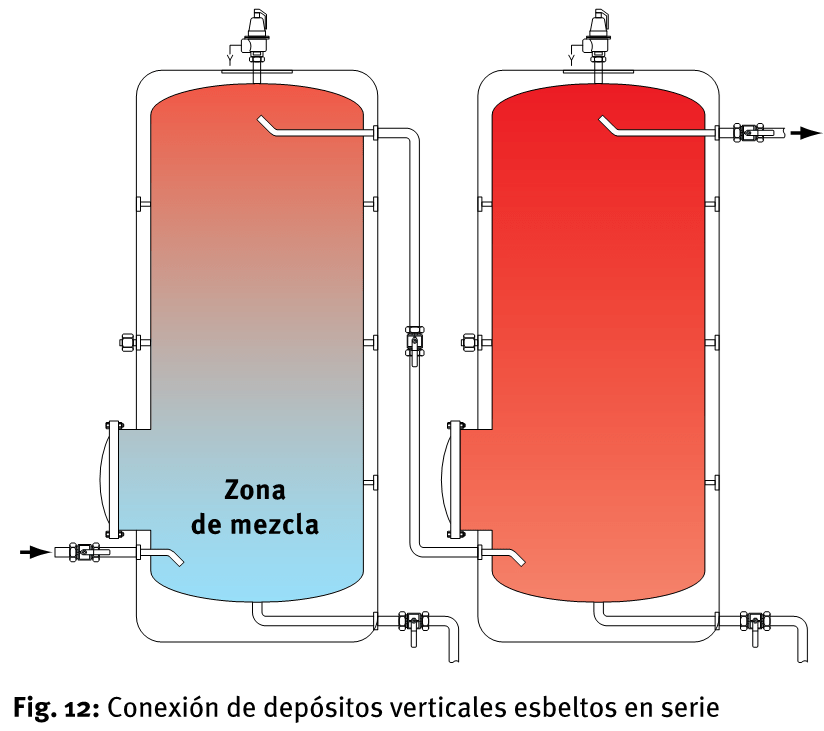
In the figure of the “Technical Guide to Domestic Hot Water” is represented.
Hydraulic connections that would go to the preheating accumulator (left).
The preheat accumulator (left) is in series with the heating accumulator.
of the heating accumulator (right and always at least at 60ºC.) is from where the domestic hot water is distributed.
There are different options to get free preheating
- Recovery chiller
They take advantage of the heat of condensation necessary to produce cold.
It is analyzed in a We Resolve technical article called “Free domestic hot water production in chillers with recovery in hotel facilities”
- solar thermal energy
It takes advantage of the solar radiation captured in a field of solar panels, for the production of domestic hot water.
- Residual heat recovery
Whenever there is a heat dissipation to the outside, air-water or water-water exchangers can be installed.
Examples
- Laundry
- Do you cook
- heated pools
- etc. etc.
There are options for low-cost preheating
- Aerothermal
- Air-water heat pump.
- Take advantage of the thermal energy of the air.
- It can be connected to air from indoor enclosures that have a higher temperature before their expulsion.
- Geothermal
- Water-water heat pump.
- Take advantage of the thermal energy of the subsoil.
- hydrothermy
- Water-water heat pump.
- Take advantage of the thermal energy of reservoirs, rivers or wells.
Generators for the production of DHW
The production of domestic hot water has traditionally been entrusted to boilers.
Lately, with the development of thermal heat pumps, other options are contemplated.
Each system has advantages and disadvantages.
From the point of view of investment, the boiler is more economical, although it consumes fossil fuels that increase air pollution.
From the ecological point of view, the heat pump, especially the necessary electrical energy, is obtained to a greater extent every day using renewable sources.
With regard to heat pumps, there are fundamental technical conditions.
The heat pump needs to produce hot water around 75ºC, because the accumulator or exchange system from where the DHW starts before its distribution must be at 60ºC., minimum.
Refrigerants used must be ecological.
Traditional refrigerants such as 134A cannot be used due to their high potential for global warming (GWP) in English or (PCA) in Spanish.
The 134a have a PCA of 1430
The R-290 (propane) has a PCA of 3 And it is an ecological gas.
The R-744 (co2) has a PCA of 1 (CO2 is used as a PCA reference)
If the outside temperature is cold, the performance of the heat pump decreases significantly, while having to select higher power models.
The compression cycle of a refrigeration circuit increases its performance when the temperature difference between the hot focus (condensation) and the cold focus (evaporation) decreases.
A heat pump that needs to produce water at 75ºC. (Condensation) with an outside temperature of (20ºC.) (Evaporation), it has a much higher yield than when it is done at an outside temperature of 0ºC.
In temperate climates and throughout the year, the performance of the heat pump exceeds that of the boiler.
In very cold climates the performance of the heat pump is greatly reduced and it is necessary to use a boiler.
In relation to the size of the generators.
The boilers are cheaper and moving from a model with less power to a larger model does not significantly increase the cost.
Heat pumps have a higher price and cost increases in higher power models are also high, which requires optimizing the selection of equipment to be installed.
In addition, it is necessary to select it for the coldest temperature at which they are going to work, which requires higher power models with respect to those that would be necessary at warmer temperatures.
Regarding hot water accumulation.
A production system with heat pumps requires a greater accumulation, due to lower power generators being installed, as a result of cost increases.
boilers
Boilers are high temperature thermal generation equipment.
Although there are electrical ones, in a hotel facility it is not viable due to energy consumption and the high cost of electricity.
They usually use fossil fuels, in the form of gas or liquid.
In some cases biomass, especially in rural environments.
Gas
- natural gas
- Propane
liquid
- usually diesel
Biomass
- pellets
- Olive bones
The tendency to a greater extent is to use gas because it is less polluting.
The boilers are equipped with a burner, which is where the combustion is carried out.
Operation
The fuel reaches the burner, where it mixes with the oxygen from the air, producing the combustion that generates a flame at high temperature.
The heat of the flame is projected to the boiler’s home and is transmitted by radiation to the metal walls of the combustion chamber, in contact with the water.
Very hot flue gases pass through a set of tubes or ducts (heat exchangers) surrounded by water. In this case, the heat is transferred by convection to the walls of the tubes and by conducting the tubes to the water that circulates through the circuit.
There are two types of boilers:
PIROTUBULARS (or smoke pipes)
- They are the most widespread.
- The gases pass through the tubes and the water surrounds them.
aquatubular (or water pipes)
- little are used.
- The water passes inside the tubes and the hot gases surrounds it
Water constitutes a closed circuit (unless there is no need to replenish it).
By the action of heat, water is brought to a temperature of 75ºC. or 80ºC. The gases from the combustion are evacuated to the outside through a chimney.
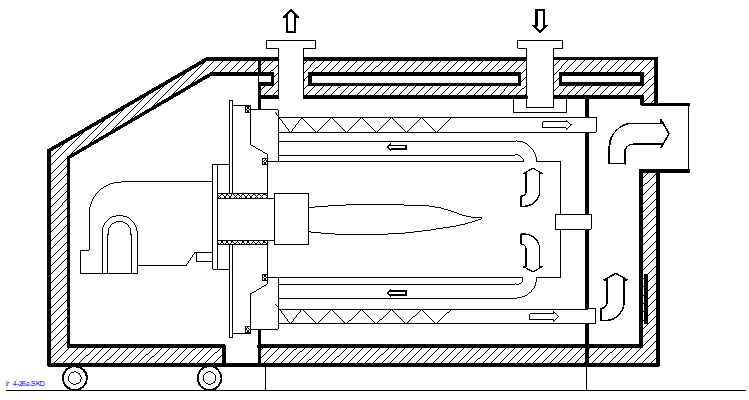
Scheme Boiler Pyronox LR and LR_NT YGNIS
Boiler performance
The energy efficiency of the boilers is set by current regulations. (In Spain the RITE).
IT 1.2.4.1.2.1 Minimum energy performance requirements for heat generators. (Modified according to Royal Decree 238/2013)
The performance of the boilers at partial load is greater than the performance at full load.
It is highly recommended to install modulating burners, which continuously regulate the power of the flame by adjusting the water outlet temperature to the setpoint, with which the energy efficiency is much higher, increases its useful life and reduces emissions.
Condensing boilers
The condensing boiler is similar to a conventional boiler to which an exchanger is incorporated.
In the conventional boiler, the combustion gases are expelled directly to the outside.
In the condensing boiler they are passed before their expulsion, through a heat exchanger through which the return water of the boiler circuit circulates.
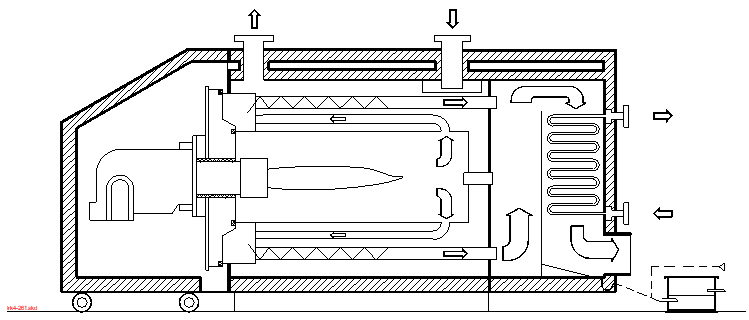
Scheme Boiler condensation version LRK YGNIS
In this exchanger, the condensation of the water vapor that the fumes carry in their composition occurs.
The condensing water is deposited on the external wall of the exchanger.
When the change of state of water vapor to liquid occurs, it gives off heat that gives it to the return water.
Subsequently, that preheated water enters the main boiler circuit, operating in the same way as a conventional boiler.
The difference with the conventional boiler is that having the condenser, it enters a higher temperature and the boiler has to provide less energy, consuming less fuel.
In the case of natural gas, the condensation of the water vapor is carried out at 55ºC. which is the dew point within the gaseous mixture of combustion fumes.
In the event that the fuel is diesel, the critical point is 47ºC.
A condensing boiler fed with natural gas, in addition to being more ecological, has a higher yield than diesel oil.
Because in the production of domestic hot water, the return temperature must be higher than 55ºC., it is not possible to take advantage of the latent heat of condensation.
It has a little more performance than a conventional boiler, although in no case due to condensation.
thermal heat pumps
Thermal heat pumps for the production of domestic hot water are high-efficiency systems that take advantage of the internal energy of the air, water or the ground, to transfer it to domestic hot water.
Aerothermal
- draws energy from the air
hydrothermy
- draws energy from the water
Geothermal
- Extract energy from the subsoil
Of these systems, the one used to a greater extent is the aerothermal system, which does not require any complementary installation.
To transfer energy from any medium to hot water, auxiliary energy, usually electricity, is required.
Thermal heat pump operation
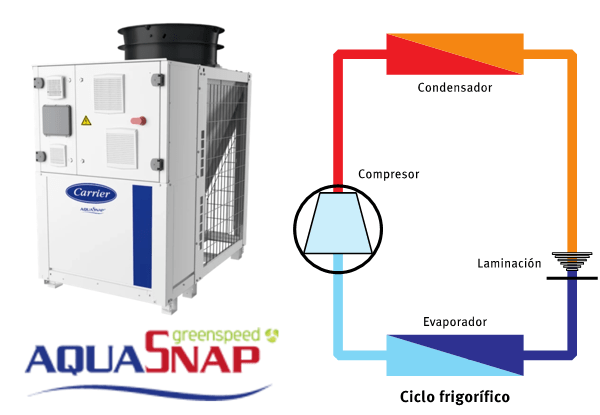
Thermal heat pumps are based on the cooling cycle.
They work just like a chiller.
Scheme Boiler condensation version LRK YGNIS
The operation of a thermal heat pump (air-water) (aerothermal) is analyzed:
Evaporator
The refrigerant enters a liquid state with a part of steam, at low pressure.
The mission of the evaporator is to convert the liquid refrigerant into steam and for this it needs to provide heat.
The heat of vaporization is supplied by the outside air (for example, winter air at (-5ºC).
This outside air, when heated, cools further and returns to the atmosphere, for example 5ºC. lower (-10ºC.)
It may seem like a contradiction that the outside air at -5ºC., provides energy in the form of heat to evaporate the refrigerant, although it is so.
Up to 0º Kelvin (0 absolute -273.15ºC.), the air has internal energy.
A fan is used to pass the air through the evaporator.
The refrigerant leaves the evaporator in the form of cold gas and at low pressure.
Compressor
It enters in the form of cold gas at low pressure, compresses and leaves in the form of hot gas at high pressure.
The compressor needs an auxiliary power source to carry out its work (usually electrical energy).
Condenser
Enter the refrigerant in the form of hot gas.
It condenses and passes into liquid, carrying out a heat exchange by heating the water from the heat pump circuit.
Liquid refrigerant at high pressure and high temperature comes out of the condenser.
Expansion valve (lamination)
Creates an expansion in the refrigeration circuit.
The high-pressure, high-temperature refrigerant expands and when expanding, a gas part is formed inside the circuit that cools the liquid refrigerant.
refrigerants
To achieve high temperatures in the production of domestic hot water and also that the gas is ecological, it is necessary to select refrigerants with special technical characteristics.
Heat pumps are sold with propane (R-290) and with CO2 (R-744).
Both refrigerants have advantages and disadvantages that go broadly from the flammability of propane to the high pressures required by the co2.
Since the project has to be carried out by an engineer, the assembly requirements will be taken into account in its implementation.
Regarding what performance is, it will depend on the temperatures with which it works depending on the location of the hotel.
the co2 (R-744), operates in a transcritical cycle. It is ideal for low outdoor temperatures and high hot water production (higher than propane).
Penalize performance with mild outdoor temperatures.
The problem of co2 It arises when it condenses at outdoor temperatures (around 17ºC.), because its performance drops.
Propane at low temperatures behaves worse than CO2.
However, as the outdoor temperature increases, performance improves.
On the other hand, the price of CO heat pumps2 are higher than propane.
If the greatest number of hours to produce ACS will be with temperatures below 17ºC. outside, it has better performance2.
If the greatest number of hours to produce DHW will be with temperatures above 17ºC., usually summer with more occupation and greater demand, propane has better yield.
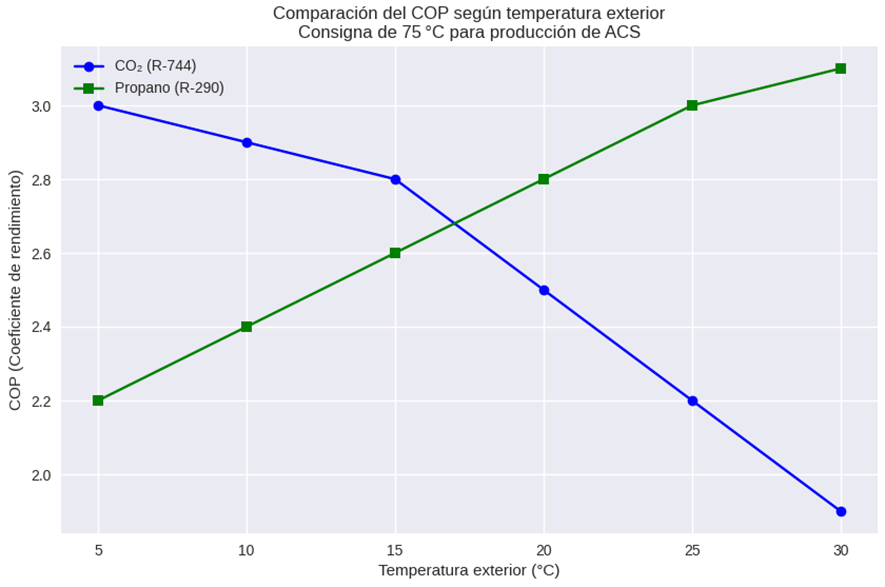
Comparison COP between co2 and propane
In a definitive study, the data offered by the manufacturers must be analyzed.
It is observed:
- at 5ºC., the COP of the CO2 (3) is superior to propane (2,2)
- at 25ºC. Propane COP (3) is higher than (CO)2) (2,2)
- at 17ºC. is the same for propane and co2 (approximately 2.7)
Refrigeration cycle performance (actual heat pump)
The performance of a heat pump depends on:
- Temperature difference between evaporation and condensation
- As the difference between the cold focus and the hot spot is greater, the machine’s performance is reduced and also produces less heat power.
- Partial load operation
- Whenever the heat pump works at partial load, the performance increases.
The manufacturer Carrier is requested to develop with its computer program of various simulations for the same machine with propane refrigerant (R-290).
The working hypotheses are as follows:
- Hot water production temperature
- input 63ºC.
- output 73ºC.
- different outdoor temperatures
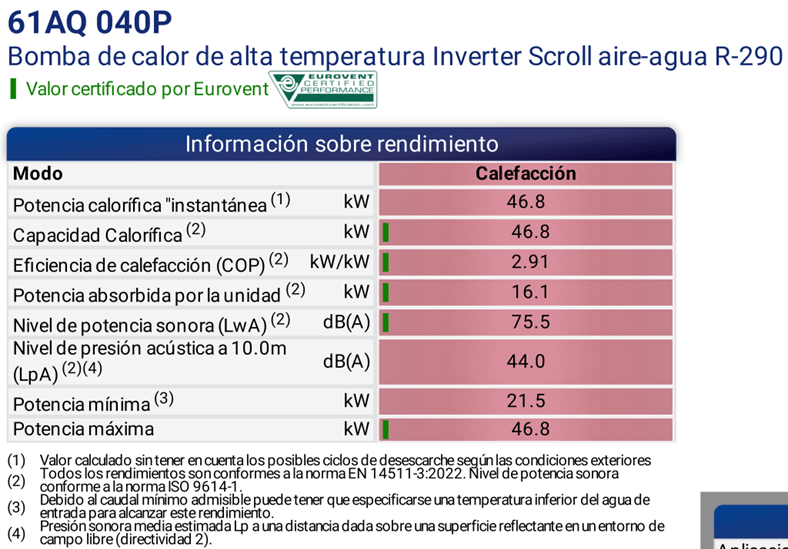
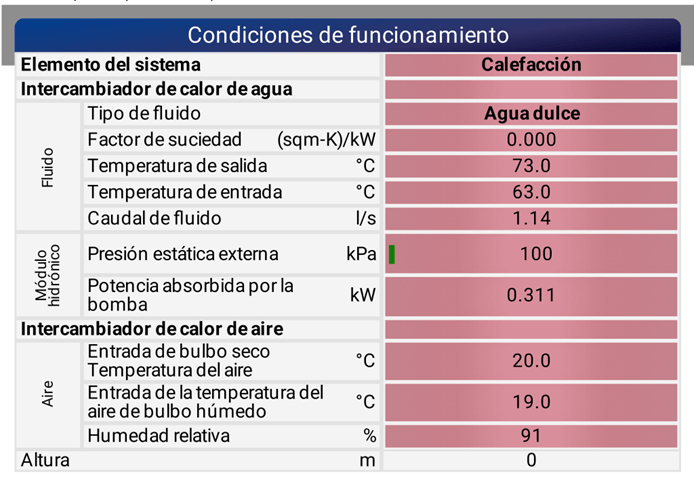
temp. Outside (ºC.) Power (kW.) Power (kW.) COP
calorific absorbed
20º 46.8. 16,1 2.91
10th 38,6 . 16,4 2.35
0º 36.3. 18.8 1.61
-10º 29. 18,3 1.59
It is observed that for the same heat pump 61 AQ 040p that the evolution of the power it provides and the energy consumption are totally variable.
from -10ºC., which provides 29 kWh., consuming 18.3 kWh. up to 20ºC. that the contribution is much higher and the consumption lower.
The COP is the ratio between the input power and absorbed power.
During the summer season the thermal heat pumps will give much higher power with lower absorbed power.
Domestic hot water production systems
Domestic hot water production systems in hotel facilities are basically:
- Accumulation
- Instant
Within these systems, there may be preheat tanks for the use of renewable energies or energy optimization.
There is always a starting point towards the domestic hot water network that has to meet the requirement of the legislation in force in each country. In Spain, the Thermal Installations Regulation (RITE) requires the necessary technical guarantees so that the origin of the DHW network is at least 60º C.
Generator power (boilers or heat pumps)
There is a correspondence between the power of the generators and the accumulation of water or energy
It is necessary to cover an energy demand and face the rush hour.
Theoretically it could be attended without any accumulation and with a very high power generator.
- When the lowest consumption occurs, the generator would enter to produce water at 60ºC.
- In that case connecting and disconnecting continuously, sometimes in seconds.
- Apart from the fact that a generator of high power has a certain inertia between connections and disconnections, the energy consumption would be very high, the environmental impact very high and the regulations do not allow it.
also the opposite case. a very small generator and a very large accumulation.
- The generator would work for many hours and the accumulation would be very high. It would have to guarantee the 60ºC. Always, even at peak times.
In the hotel facilities, both situations must be analyzed.
If the heating is carried out with boilers, which are cheaper and there is a lesser cost difference between the power scales, the most appropriate solution is to reduce the accumulation by increasing the power. If the heating is carried out with heat pumps, which have a higher price that increases significantly when the power increases, the solution should be proposed in reverse terms, that is, more accumulation and less power in the generator.
Accumulation systems for heating
Whenever it is for heating, it is necessary to ensure the 60ºC. in production.
They are made up of:
boilers, heat pumps or any system that guarantees 60ºC. in the accumulator or accumulators.
Accumulators with thermally insulated tanks, intended to store domestic hot water.
Heat exchange system between boiler hot water or heat pump and domestic hot water.
- If the exchanger is located at the bottom of the accumulator, it is guaranteed that the deposit is at a minimum temperature of 60ºC.
- If the exchanger is located outside the accumulator, which is usual (plate exchangers), it is necessary to reverse recirculate to homogenize the temperature, so that the minimum is equal to or greater than 60ºC.
- Stratification systems that can leave a part of the accumulator below 60ºC are not valid.
In all cases, the accumulator temperature control probe must be located at its bottom.
Instant Systems
They always have to ensure 60ºC. in production.
Instant systems do not accumulate water, but heat it to the way.
As stated, production systems cannot be designed to heat water, because the demand is highly variable.
A boiler cannot be installed for a system that needs to provide 20 liters at a time and at another time 10,000 liters.
In an instantaneous system for hotel facilities, it is necessary to consider installing inertia tanks that maintain a water reserve similar to those that could be required of accumulators, although at a temperature that would be at least between 70ºC. and 75ºC. (A deposit of inertia is attached to the primary boiler or heat pump circuit and is used to accumulate thermal energy)
In this aspect, the space that these systems usually indicate in their publicity to eliminate accumulators of domestic hot water, they must be used with inertia deposits.
The system would consist of:
- boilers, heat pumps or any system that guarantees 75ºC. in inertia deposits.
- Inertia tanks to store thermal energy
exchanger.
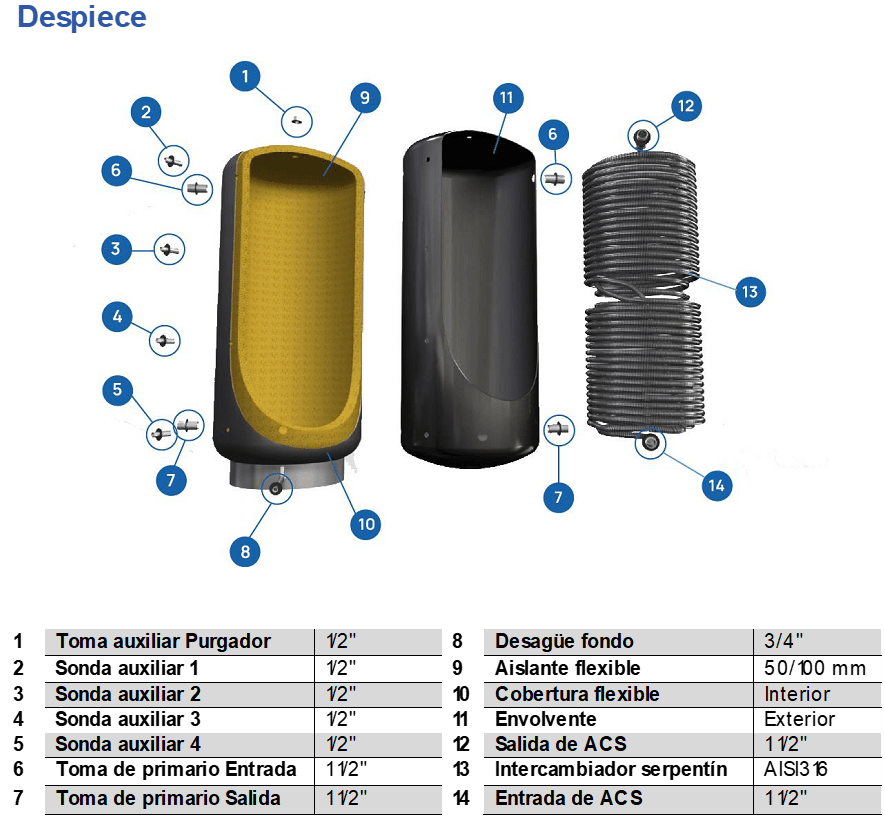
TECHNICAL SHEET HYDRONIK
Extracting exchanger for instant ACS production
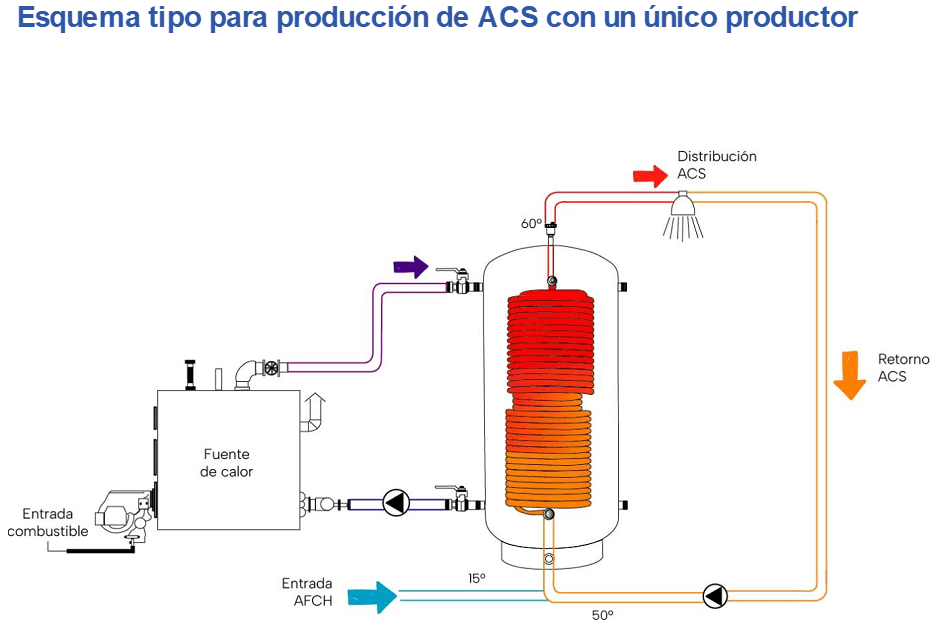
Scheme listed on the Hydronik Data Sheet
In a hotel and given that the boiler cannot respond to minimum instantaneous demands, a deposit of inertia should be placed between the boiler and the exchanger.
The boiler always maintains the inertia deposit at a temperature for example between 70ºC. and 75ºC. and from the inertia deposit by means of a pump group it is connected to the primary of the exchanger (the area that surrounds the coil).
Advantages and disadvantages of accumulation and instantaneous systems
They are analyzed from the point of view of meeting the demand with similar generators in both cases, which leads the instantaneous system to implement inertia tanks to accumulate thermal energy.
accumulators
Advantage
- They store water at a lower temperature with respect to the inertia tanks that must be installed in instantaneous systems.
- Stable drive temperature.
Disadvantages
- They require greater maintenance to comply with the precepts required by the Legionella Control Regulations.
instant
Advantage
- Less maintenance with respect to the Legionella by eliminating the risks that may arise in the accumulators.
Disadvantages
- The inertia deposits have to store water at a higher temperature, thus increasing energy losses through their walls.
- They require sophisticated control to ensure a minimum fixed outlet temperature of 60ºC.
- They must be continuously adapted to the cold water inlet temperature and the variable demand of the installation.
- They must be designed for the lowest temperature of cold water.
Domestic hot water production systems
In the hotel facilities there are cases in which free energy is available for preheating of domestic hot water.
- Recovery chiller
- solar energy
- Other residual heat source
However, there are other cases in which these sources are not available.
There will be installations where the convenience of installing pre-heat accumulators for domestic hot water is proposed, which can be used both in accumulation systems and in instantaneous systems.
Being elements that do not strictly belong to the production of ACS, they do not require continuous treatment on the legionella. They will have the required for accumulation deposits.
Optimization with condensing boilers
Condensing boilers, as stated in this article, cannot take advantage of condensing energy in the production of domestic hot water because the return is greater than 55ºC.
However, if a preheat tank is installed at a lower temperature, it is possible to preheat the cold water to a temperature for example of 45ºC, taking advantage of the performance provided by the condensation.
Optimization with thermal heat pumps
The performance of heat pumps depends on the temperature difference between evaporation and condensation.
As stated in this article, as the difference increases, the yield decreases.
There can be installations especially in cold climates and low outdoor temperatures, in which in addition to thermal heat pumps there are gas boilers to give the final heating to the production of DHW.
In that case, it could be profitable, as in the case of condensing boilers, preheating the water with the thermal heat pump and that the boiler is only in charge of increasing the temperature at times of very low outside temperature, logically in the heating tank.
Another aspect that I would recommend preheating with heat pumps is that as the outside temperature is colder, they not only have less performance, but also provide less power and pre-heating would be very beneficial to optimize the size.
Energy optimization ACS production
The production of domestic hot water is carried out by generators (boilers or heat pumps).
To optimize the operation energy, it is very important that the generators are not continuously connecting and disconnecting.
In the case of a gas boiler, for example, every time it is stopped, it is necessary to sweep gases in the combustion chamber, providing intense ventilation at room temperature, to ensure that there are no traces of fuel left unburned.
In each start cycle there is a cooling of the combustion chamber.
In the case of thermal heat pumps there are also energy losses in connections and disconnections, although less significant than gas boilers.
In the heat pumps, to start the compressor, the energy absorbed is increased in those first moments.
After starting, the refrigerant needs time to reach the optimal pressure and temperature to perform the refrigeration cycle.
Therefore, whatever generator is, the ideal is to reduce starting and stopping as much as possible.
For this it is necessary to act on the instructions of the accumulators or deposits of inertia.
If, for example, an accumulator we want to keep it between 60ºC. and 61ºC.
- when the temperature reaches 61ºC. The generator is disconnected.
- Upon reaching 60ºC, it connects.
If instead of between 60ºC. and 61ºC., we put the setpoints between 60ºC. and 64ºC., the connections and disconnections of generators will be reduced to a quarter.
Although the average temperature in the case of between 60ºC and 61ºC, is 60.5ºC. and in the case of between 60 ºC. and 64ºC., is 62ºC., slightly increasing the losses due to transmission of the accumulator through its walls, it is practically insignificant with respect to what quadruling starts and stops.
Nor should we forget that frequent starts and stops penalize the life of machinery, elements and equipment.
Another very important aspect in energy consumption are (types of burners in boilers) and (types of motors in heat pumps).
In boilers, modulating burners must be installed that always maintain the same outlet temperature and allow longer operation, reducing the number of starts and stops to the strictly necessary.
The same occurs in heat pumps using inverter technology that allow continuous power modulation in compressors and fans.
There are a high number of facilities in hotels, carried out with outdated criteria in which the pump groups of the circuits are always kept in operation
Boiler – ACS heat exchanger
DHW heat exchanger – accumulators
Normally, a 3-way valve was installed on the primary (boiler-exchanger ACS) that received secondary information and regulated the outlet temperature of sanitary water in the DHW exchanger.
The three-way valve acts on the flow of water coming from the generator to the plate exchanger and thereby adjusts the fixed outlet temperature to accumulators.
This type of operation (very long ago), severely penalizes energy consumption. If the philosophy is to maintain a constant temperature, the connections and disconnections of generators are multiplied.
Therefore, in hotels where this type of operation still exists, it is recommended to modify it and establish setpoints in the accumulator between a maximum and a minimum, leaving the three-way valve fixed.
Summarizing:
- It is necessary to minimize the start and stop of generators.
- For this it is necessary:
- Increase the range between the start-stop setpoints by means of a probe located at the bottom of the accumulator.
- That way the run time is longer.
- Install modulating burners in the case of boilers.
- Install inverter technology in the case of thermal heat pumps.
- In old installations, correct the fixed temperature operating mode at the output of the DHW exchanger.
- For this it is necessary:
Ecological and economic comparison between boilers and thermal heat pumps
Maybe it’s the big question.
When should I use boiler and when heat pump
In this case, the country where it is analyzed is very important due to the implementation of renewable energies in electricity production.
If there is only renewable energy in a country, the conclusion is very simple at the ecological level. Always heat pump because it uses electricity and does not pollute anything.
Another aspect is economic.
What is the cost of kWh, using fossil fuels or electrical energy, this aspect being very variable due to the volatility of the price of energy.
The case of Spain is analyzed where there is a large implementation of renewable energy in electricity production.
The comparison will be made between a thermal heat pump that uses propane refrigerant and a natural gas boiler. According to the official document of Miteco (Ministry for Ecological Transition and Demographic Challenge), the non-renewable primary energy step factor for electricity in 2024 is 0.283, which reflects a high percentage of renewables in the Spanish electrical mix.
Ecological Comparison
- It is done by analyzing the COP
- COP is the relationship between the energy provided and the energy consumed.
- Natural gas emission factor: 0.20 Kg. CO2/kWh. (combustion)
- Electricity emission factor 0.283 kg CO2/kWh. (Mix 2024)
- boiler efficiency 0.95
- With these data, the ecological COP is 1.34
- If the heat pump has a COP less than 1.34, the boiler is more ecological.
Economic Comparison
- Natural Gas Price: €0.05/kWh.
- Electricity Price €0.15/kWh.
- Boiler efficiency 0.95
- In this case, the economic COP is 2.85
- As long as the heat pump does not reach a COP equal to or greater than 2.85, it is more economical than the boiler.
If these prices and these criteria are modified, the COP would also change.
It is an example with indicative data, which will have to be analyzed in each specific case.
management and control
The management and control system is essential for energy optimization in the operation of the facilities.
The production of ACS involves:
generators
- The production setpoints are adjusted to the requirements of the installation.
- As the accumulators are approached to setpoint values, the production temperature in the generator can be lowered, so that it is achieved:
- Improve the energy performance of the generator itself
- Reduce the number of connections and disconnections.
Example:
- A heat pump produces hot water at 73ºC.
- In the DHW accumulator, a setpoint of 60ºC has been established. at 64ºC.
- A communication can be established so that when the accumulator is for example at 60.5ºC. Produce hot water at 73ºC. and when it is at 63ºC, produce hot water at 71ºC.
- The yield is higher when it produces at 71ºC.
- It takes longer to disconnect, reducing connections and disconnections.
They preheat water
Let’s analyze the case of a condensing boiler.
- If a preheat accumulator is installed.
- Once the heating accumulator has reached its setpoint and before stopping the generator.
- It is regulated to heat the preheat accumulator for example to 45ºC., taking advantage of the heat of condensation and reducing energy consumption.
Generator management
In cold climates it can be interesting ecologically and economically to stop producing domestic hot water with a heat pump when a certain POP is reached.
In that case the management system could choose to:
- Enable the gas boiler to replace the heat pump because it is more ecological at that time.
- Use the heat pump if there is a preheat accumulator if its COP is better than the one offered by the condensing boiler.
BOM groupsBA
- Pump groups should only run for the minimum time required.
- The ideal is to use pump groups with speed variation, to adjust the consumption to the real needs of the installation.
- When the generators are disconnected, since there is no energy transfer, the pump groups must be disconnected with the sequence that is established.
The functions of a management and control system are very extensive and offer, as seen in the example, many energy saving options.
It is essential that it be the engineer who develops the DHW production facility who establishes the criteria and modes of operation and always leaves the possibility for the operator to establish the slogans at all times.
mandatory maintenance
In thermal installations and other complementary installations that affect the production of DHW, maintenance is mandatory and must be carried out by qualified companies that have personnel with the qualification required by current legislation.
In this case they are perfectly specified in the Royal Decrees:
Royal Decree 487/2022, of June 21, establishing the sanitary requirements for the prevention and control of legionellosis.
Royal Decree 614/2024, of July 2, which modifies Royal Decree 487/2022, of June 21, which establishes the sanitary requirements for the prevention and control of legionellosis.
Royal Decree 178/2021, of March 23, which modifies Royal Decree 1027/2007, of July 20, which approves the Regulation of Thermal Installations in the Buildings.
Table 3.3 Preventive maintenance operations and their periodicity
Royal Decree 809/2021, of September 21, which approves the Regulation of pressure equipment and its complementary technical instructions.
Royal Decree 3/2023, of January 10, which establishes the technical-sanitary criteria of the quality of the water for consumption, its control and supply.
In addition to energy optimization, the regulatory provisions are aimed at guaranteeing safety and health aspects, as well as extending the useful life of machinery, elements and equipment.
Conclusions
Domestic hot water (ACS) is a basic service in hotel facilities.
The production of DHW requires a high energy consumption, so it is necessary to look for alternatives that reduce it.
A good option is to install preheat tanks where energy can be accumulated from renewable sources, surplus heat and optimization of yields in heat production systems.
Preheating can be at any temperature and takes advantage of free heat (condensation of chillers, solar energy, residual heat) installed, or produce it at a lower cost (heat pumps, boiler condensation).
Preheat tanks are not subjected to any periodic treatment on the legionella, only those existing for drinking water tanks.
The Thermal Installation Regulations (RITE), and the periodic controls required for Legionella, only affect heating.
For the production of ACS, boilers and thermal heat pumps are basically used.
The decision on one or another system involves economic, ecological and technical aspects.
Heat pumps to produce ACS have to be equipped with special refrigerants capable of producing water at high temperatures and be ecological.
The performance of heat pumps varies based on the differential between condensation (related to the DHW production temperature) and outside temperature.
- As the differential increases, the heat pump supplies less power and its COP (relationship between the power provided and consumed) decreases.
Boilers are traditionally the elements used in the production of domestic hot water.
They use fossil fuels (gas or diesel), although there are also biomass.
They are generally more polluting, although exceptionally in very cold climates, natural gas can be more ecological at times than heat pumps.
Recently, due to yield requirements, condensing boilers are being used to a greater extent.
- They have an auxiliary condenser whose mission is to take advantage of the latent heat corresponding to the water vapor contained in the smoke.
- It is used to preheat water before entering the boiler heating circuit.
- In the case of DHW production, it is not possible to take advantage of the latent heat of condensation, because the return temperatures of the boiler water are higher than 55ºC. and the limit is in (natural gas 55ºC. and diesel 47ºC.).
Thermal heat pumps take advantage of the energy of the air, the water or the subsoil to produce hot water.
Its operation is based on the refrigeration cycle and they work the same as a chiller.
They can extract energy from the air, even at temperatures below 0ºC, using auxiliary energy, usually electricity.
The energy extracted is the one used to heat the water.
Propane (R-290) and CO refrigerants are currently used as refrigerants.2 (R-744).
Propane heat pumps are more economical and have a higher yield from 17ºC, so in summer they are much higher than those of CO.2.
Domestic hot water production systems, normally used, are through storage of water in accumulators of ACS, or instantaneous.
In the case of instantaneous production, it would be necessary to install inertia deposits attached to the heating circuit of the generator, because the consumption is highly variable and would require generators of very high power.
There is a relationship between the power of the generators and the accumulation needs.
In instantaneous production, since there are no domestic hot water accumulators, there is no possibility that Legionella develops in accumulation and reduces maintenance.
On the contrary, energy losses in the inertia tanks are increased and it requires a more sophisticated system of production of ACS.
It may be interesting to install preheat tanks, whether you can take advantage of free renewable energy, or if you can take advantage of the yields of the generators.
It would be the case of preheating water using the condensation of the boilers, or a smaller difference between the evaporation temperature and condensation in the heat pumps.
To optimize the production of DHW, it is necessary to reduce the number of start and stop of the generators.
Every time a start-stop occurs in a generator, energy is lost, both in boilers and in heat pumps, significantly reducing seasonal performance.
Use boiler modulating burners and inverter technology in heat pumps, increase performance and reduce energy consumption.
It is recommended to analyze and correct the production criteria of DHWs in hotels with three-way valves in the primary of the exchanger, due to the number of unnecessary starts and stoppages they cause.
It is necessary to analyze the ecological and economic comparisons between boilers and heat pumps for any installation that is carried out, taking into account:
- fuel contamination.
- electrical mix of the country.
- generator yields.
- fuel prices.
With very cold outdoor temperatures, there will be times when a gas boiler is more ecological than a heat pump.
In operation with normal temperatures, the heat pump will be more ecological.
It is also convenient to analyze the evolution of prices to make economic decisions.
The management and control system is of great importance in the regulation of generators and production systems.
- Communication gateways can be established that optimize energy consumption at all times and manage the set of generators.
The ACS production facilities are part of the thermal installations and in addition to the Thermal Installations Regulation (RITE), it is affected by others that are mandatory, such as those of technical-sanitary criteria in the quality of the water, those of pressure equipment and those required by the Legionella.
In the production of ACS it is mandatory to carry out and document them.
Maintenance must be carried out by qualified companies and served by technicians with the professional qualification required by current legislation.
Good preventive maintenance reduces energy consumption and avoids safety and health risks.
We Resolve as a company of integral maintenance of unique buildings, with extensive experience and implementation in the hotel sector (in Spain and America), has a technical department in which the pathologies, integration, optimization and improvements that occur in the field of facilities are analyzed.
In the case of energy optimization in the production of domestic hot water, it has extensive experience, which allows the necessary guarantees to be maintained to maintain the facilities within the required health and safety parameters, optimizing the cost and improving sustainability.
Literature
THERMAL INSTALLATION REGULATION
https://www.miteco.gob.es/es/energia/eficiencia/rite.html
Royal Decree 809/2021, of September 21, which approves the Regulation of pressure equipment and its complementary technical instructions.
https://www.boe.es/diario_boe/txt.php?id=boe-a-2021-16407
Royal Decree 3/2023, of January 10, which establishes the technical-sanitary criteria of the quality of the water for consumption, its control and supply.
https://www.boe.es/buscar/act.php?id=boe-a-2023-628
Royal Decree 487/2022, of June 21, establishing the sanitary requirements for the prevention and control of legionellosis.
https://www.boe.es/buscar/act.php?id=boe-a-2022-10297
Royal Decree 614/2024, of July 2, which modifies Royal Decree 487/2022, of June 21, which establishes the sanitary requirements for the prevention and control of legionellosis.
https://www.boe.es/buscar/doc.php?id=boe-a-2024-13422
Comments to Rite 2007
Technical guide Water air conditioning installations
We resolve case studies (energy optimization in refrigeration production)
Domestic hot water in chillers with recovery in hotel facilities
Technical Guide Domestic Hot Water
Hydronik exchangers
https://hydronik.es/teams-de-produccion-acs-para-hoteles