


Previously we talked about sanitary water, in a case study dedicated to Materials admitted in the sanitary water. This time we will focus on hot water.
Background
The school Aloha de Marbella Nestled in the Aloha Golf urbanization, he built some new changing rooms for his sports complex in 2017. The Installation for DHW (domestic hot water) It was basically made up of:
- diesel tank
- two boilers
- two accumulators
- pumping equipment.
It is a conventional installation that:
- Use fossil fuels
- It is polluting
- It has a high energy consumption
- presents health risks.
- Requires exhaustive and professional maintenance given the risks of fuel and boilers in terms of safety
- Water consumption is higher than necessary
The environmentally sensitized property commissions a new project in which the following parameters are taken into account:
- Salubrity
- Security
- Comfort
- environmental impact
- Optimization of energy consumption
The design is carried out by the We Resolve Engineering Department, the same company that was in charge of the installation and is in charge of maintaining it.
A year later it is expanded to serve the production of kitchen and kitchen changing rooms, installing a new equipment of the same characteristics.
new installation
1
The new installation basically consists of:
- Production of DHW (sanitary hot water) using free energy from outside air as an energy source Aerothermal and as auxiliary power electricity.
- Energy accumulation in inertia tank.
- AQUA PORT EQUIPMENT FOR INSTANT DHW PRODUCTION
It is a state-of-the-art facility with a high component of (R+D+i) (Innovation Development Research)
It uses the Aqua Port equipment manufactured by the multinational Uponor in its German factory for the production of domestic hot water, being The first Aqua Port team to be installed in Spain; tolending the highest degrees of sustainability by using renewable energy sources.
Brief description
- The heat energy obtained from outside air (aerothermal) by means of a thermal heat pump is stored in a tank of inertia.
- Domestic hot water is produced in the Aqua Port unit instantly.
- The outlet temperature is set by the user.
- Between the inertia tank and the Aqua Port equipment there are only two connection tubes for the primary circuit (heat production)
- The location of the Aqua Port equipment is located at a distance of less than 15 meters from the points of consumption, so it is not necessary to establish any return of DHW.
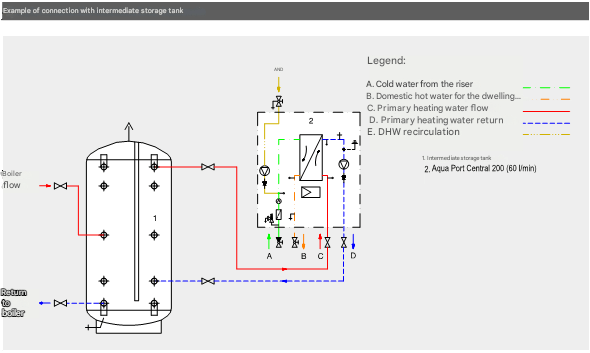
Description of operation
This is an installation that only gets started when DHW needs to be produced:
- The control gives the order to the thermal heat pump to heat the inertia tank to the necessary temperature, based on the intended use.
- The Aqua Port equipment heats the water instantly and only the one consumed.
It is basically made up of:
- Pump to capture energy from the inertia tank.
- Exchanger to transfer the energy taken from the inertia tank to the drinking water.
- complementary and control elements.
The operation is as follows:
- The water from the distribution network arrives at the Aqua Port equipment.
- When a supply is activated (for example a shower):
- The pump installed on the equipment that connects the inertia tank with the primary of the plate exchanger comes into operation.
- The pump is of variable speed and only pumps the required flow at each moment.
- Heat exchange occurs in the exchanger installed inside the equipment.
- The water comes out at the set temperature.
Conclusions
The executed installation complies with the parameters of:
Salubrity
- As there is no accumulation of water, nor return of DHW There is no risk of contamination by Legionella. (Exclusively the water consumed and at that time is heated).
- A conventional installation presents potential risk of legionella.
Security
- There is no fuel storage.
- There are no boilers.
- There are no burners where the combustion takes place.
Comfort
- The outlet temperature of the water is at the time of use, around 37°C, or whatever is desired.
- A conventional installation requires water to be greater than 50°C, and mix before consumption.
environmental impact
- There is no environmental impact, totally eliminating contamination by harmful gases in the school environment.
- Globally, auxiliary energy (electricity) is produced to a greater extent using renewable energy sources.
- Use only the water that is consumed.
- A conventional installation consumes a greater amount of DHW.
- daily tests on taps.
- accumulator drains.
- purges.
- Periodic cleaning.
energy consumption
- Energy consumption is much lower than that of a conventional installation with fossil fuels
- The energy source is free (Aerothermal).
- The energy consumption in auxiliary energy (electricity) is relatively small.
- In Marbella the temperatures are warm and the heat pump performance is quite high.
- Exclusively it works as long as necessary and the installation is out of service when not in use.
- Only the water consumed is heated.
Maintenance
- It is significantly reduced by completely eliminating the risks of health (legionella) and safety (fuel tank and boilers).
Sustainability
- The executed facility provides the highest sustainability parameters for the production of domestic hot water.
TECHNICAL ANNEX
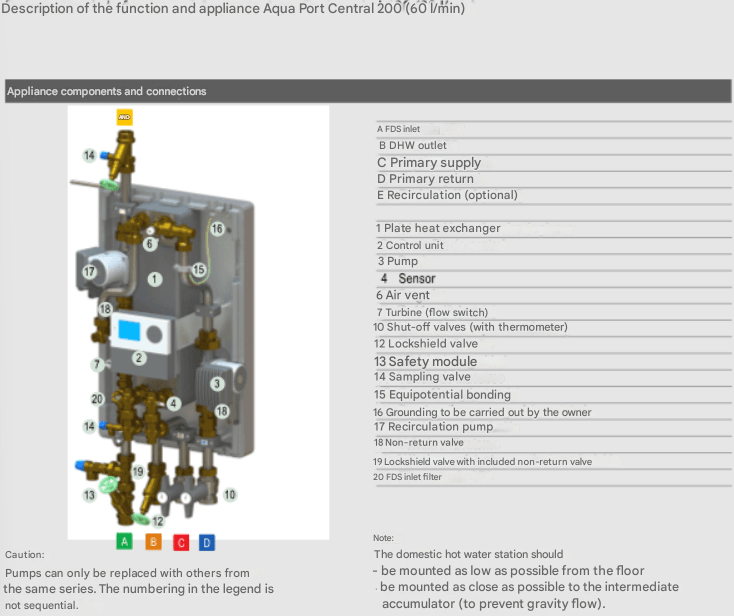
The team Aqua Port Installed is made up of the following elements:
- The connection E corresponding to an optional recirculation has not been used, which in this case is not accurate.
- Cold water from the mains enters by its own pressure.
- The hot water comes out of B by its own pressure
- The connection with the inertia tank that is the energy source for the production of DHW enters by C
- returns to the inertia tank by d.
- In order to convey the water between the inertia tank and the Aqua Port equipment, a pump group incorporated in the equipment (3) is necessary.
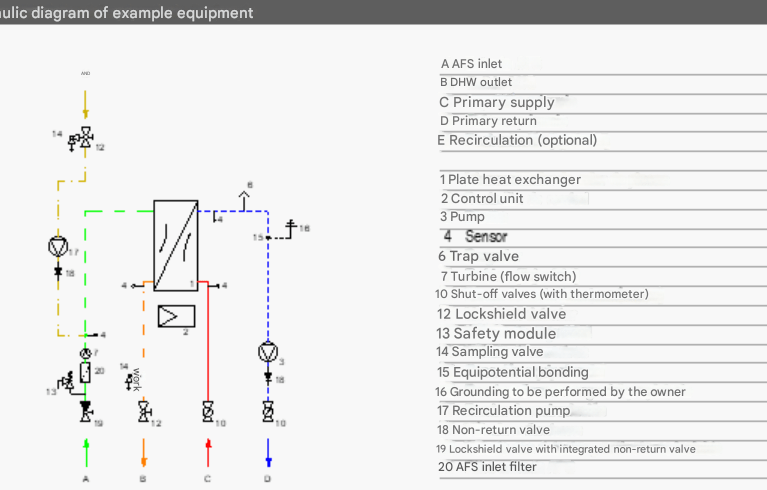
The operation of the equipment is explained by indicating temperature values for a better understanding.
Temperatures are regulated by the user.
The domestic cold water enters through A using its own pressure.
- The temperature is network and variable (example 14°C)
Domestic hot water comes out of B using its own pressure and from there it goes directly to the points of consumption.
- In the control unit (2) the outlet temperature is set. (example 36°C)
To heat the water that enters, for example, at 14°C, and we ask that it come out for example at 36°C, it is necessary to provide thermal energy. This energy is supplied in a plate exchanger (1) that receives hot water from the inertia tank in its primary, through the action of a pump (3) installed on the equipment.
- The pump (3) is of variable flow.
- The flow required at each moment will depend on:
- Set set temperature (example 36°C)
- Water temperature in the inertia tank (example 50°C)
- Demanded flow that depends on the number of open taps.
- The control unit receives information from:
- Domestic hot water outlet sensor (4) (output B)
- Hot water inlet sensor (4) from the inertia tank (heater fluid)
- Sensor (4) of hot water outlet returning to the inertia tank (heater fluid)
The switchboard processes the information received at each moment.
If you observe that the outlet temperature of the domestic hot water, which is intended to be controlled, tends to drop from the setpoint value (in this case 36°C) gives the order to the pump (3) so that its speed increases and provides a greater flow to the primary of the exchanger (1) in case of to note that the tendency is to rise from the setpoint value (in this case 36°C), it gives the order to decrease the number of revolutions so that less water passes through the primary of the exchanger (1)
When there is no water passage, the pump stops. The equipment only works when necessary and there is demand for hot water. It is automatically put into service at the moment when consumption occurs and that is detected by a flow-stat (7) located at the cold water inlet (A).
In this installation, since there is no DHW return, it is not necessary to mount the pump 17 and that connection remains closed.
The main differences between a conventional installation such as the one initially executed and the one made are exposed.
Accumulator for domestic hot water
In a conventional installation the DHW accumulator requires:
Royal Decree 865/2003 (Legionella)
- Quarterly review
- Weekly purge bottom
- daily control of temperature accumulator of DHW verifying that the temperature is equal to or greater than 60°C.
- Check that the temperature in the accumulator is homogeneous, avoiding cooling of the lower areas.
Royal Decree 1027/2007 (RITE)
- accumulation temperature control;
Royal Decree 314/2006 CTE (DB-HS4)
- In the DHW facilities, the preparation temperature will be regulated and controlled.
In the executed installation there is no accumulator for domestic hot water, and, therefore, the indicated royal decrees do not affect it.
Distribution
In a conventional installation the DHW accumulator requires:
Royal Decree 865/2003 (Legionella)
- Keep the temperature in the drive and return circuit always above 50ºC. at the furthest point from the circuit or the return pipe to the accumulator.
- The installation will allow the water to reach a temperature of 70ºC.
Royal Decree 1027/2007 (RITE)
- control of the water temperature of the pipe network at the hydraulically furthest point of the accumulator;
Royal Decree 314/2006 CTE (DB-HS4)
- The distribution network must be equipped with a return network when the length of the pipe from the way to the farthest point of consumption is equal to or greater than 15 m.
- In the DHW facilities, the preparation and distribution temperature will be regulated and controlled.
In the executed installation there is no return of domestic hot water. Only branches to terminal points less than 15 m, and the indicated royal decrees do not affect it.
terminal points
Royal Decree 865/2003 (Legionella)
- Review and monthly control of a representative and rotary number of the terminal points, verifying that the outlet temperature is greater than 50°C. (near and away from the accumulator).
- At the end of the year they have to be 100% revised.
- Weekly, opening of unused taps and showers letting the water run for a few minutes.
The executed installation does not require any control as it is instantaneous heating.
Purges
Royal Decree 865/2003 (Legionella)
- Monthly purge Drain valves in pipes
The executed installation does not require any purge.
Thermal shock
Royal Decree 1027/2007 (RITE)
- Control to carry out heat shock treatment
- security control for users.
The executed installation does not require thermal shock.
Cleaning and disinfection
Royal Decree 865/2003 (Legionella)
- Cleaning and disinfection
- Chemical disinfection by chlorine
- Thermal disinfection
- Any method involves significant water and energy consumption.
- First of all, for cleaning
- Then, sending the disinfected or hot water at 70°C to all the terminal points.
- In the case of thermal disinfection after cleaning, it requires water to come out at 70°C, for all taps for at least 5 minutes.
The executed installation does not require cleaning since there is no accumulation of DHW.
Boiler maintenance
Royal Decree 1027/2007 (RITE)
- The boiler is an element that if it is not maintained correctly is potentially dangerous.
- Hence the RITE establishes a series of preventive actions in maintenance that guarantees the safety of the facilities.
Boiler has not been installed.
Comfort
Royal Decree 865/2003 (Legionella)
- As the distribution temperature is greater than 50ºC, it requires at the terminal points or in the shunt sections to them below 15 meters, mixing devices to bring the water to the temperature of use.
The outlet temperature is the one set by the user (normally between 35°C and 38°C).
energy losses
Royal Decree 865/2003 (Legionella)
- During the periods that the installation is in service, the accumulator must necessarily be at a temperature above 60°C, and the distribution network when it is equipped with a return at a temperature above 50°C, so that energy losses are important.
- Likewise, in the installations with a return, the domestic hot water return pump must be continuously operated during the time that the installation is in service.
- On the other hand, if the tank does not reach 60°C, the installation of DHW cannot be used.
In the installation made, the inertia tanks have no demand and can be at temperatures below 60ºC., there is no return network and the energy losses are much lower.
Environmental pollution
By not using fossil fuels, there is no spread of smoke with contaminating particles in the environment.
At a general level, when using aerothermal energy and as auxiliary energy, the CO₂ footprint is reduced considerably and more every day, due to the fact that non-polluting renewable energy sources are increasingly used.
Kitchen installation
In the kitchen there was an electric thermos that served the sinks and changing rooms. Having a relatively high warm-up period, the service it provided was very poor. All the energy it contributed to the installation was produced by electrical resistance, (860 kcal) for each kWh, which is the least efficient system of those used.
The performance of the new system implemented is far superior to the existing one and adequately attends to the needs of the installation.
regulations
The Legionella Royal Decree does not affect the installation executed, if the conventional ones.
- Legionella Royal DecreeRoyal Decree 865/2003, of July 4, which establishes the hygienic-sanitary criteria for the prevention and control of legionellosis”
https://www.boe.es/buscar/pdf/2003/boe-a-2003-14408-consolidado.pdf
The RITE totally affects conventional installation. (boilers, burners, fuels, accumulators, hot water production, pumps, insulation, etc.). In this case there is only one heat production equipment.
- rite (Regulation of Thermal Installations) Royal Decree 1027/2007, of July 20 and subsequent modifications
https://www.boe.es/buscar/pdf/2007/boe-a-2007-15820-consolidado.pdf - cte Technical building code (DB-HS4) Royal Decree 314/2006, of March 17 and subsequent modifications
https://www.codigotechnico.org/pdf/documentos/hs/dbhs.pdf
Uponor
26/01/2022
José Arroyo Martín
Ingeniero Tecnico Industrial en Electricidad y Mecánica