

ENERGY
Optimization
production of
refrigeration in
HOTEL
INSTALLATIONS
Introduction
Energy efficiency is crucial in hotel operations, especially in energy consumption for refrigeration. Energy optimization not only reduces costs but also contributes to sustainable practices, an aspect valued by both customers and investors.
The highest energy consumption in a large part of hotels is produced in refrigeration, with the highest percentage corresponding to the production system.
A hotel facility requires maintaining comfort parameters and at the same time optimizing the resources used.
Whenever less energy is consumed, the environmental impact is reduced.
Applying appropriate techniques, it is possible to significantly reduce the energy necessary for the refrigeration production.
This article will analyze the refrigeration production carried out in the chiller itself and the technical aspects that maintaining, or even increasing comfort, significantly reduce the energy consumed.
The techniques that must be implemented when there are several chillers are not addressed and how it should be managed through the management and control systems, which would be complementary to those set forth here.
Basic concepts of refrigeration production
The refrigeration production consists of extracting the existing heat in an enclosure, in order to reduce its temperature.
At an industrial level, two techniques are preferably used to achieve this:
- Compression cooling
- Absorption refrigeration
The most used is compression refrigeration.
Only in those processes where there is an amount of residual heat at high temperature, it is profitable to take advantage of it to produce absorption refrigeration.
Cold production in chiller plant
Compression refrigeration is a thermodynamic cycle in which variations of pressure, temperatures and changes of state occur in a closed system.
A refrigeration circuit is basically made up of:
- 1 compressor
- 1 Capacitor
- 1 expansion valve
- 1 evaporator
In the refrigeration circuit there are two perfectly differentiated sectors, the high pressure and the low pressure sectors.
In the graph:
- 1 represents the condenser (high pressure sector)
- 2 represents the expansion valve (limit between high and low pressure)
- en The expansion valve causes pressure drop.
- 3 represents the evaporator (low pressure sector)
- 4 represents the compressor (limit between low pressure and high pressure).
- The compressor is the one that causes the pressure rise.
In the description of the process, it is considered one of the chillers that usually installed in the centralized hotel facilities.

Air-water chiller:
- Use the air to condense.
- Use water to evaporate.
Compressor (4)
- The compressor (4) receives the gas-shaped refrigerant from the low pressure circuit.
- It provides external energy to work (usually electric).
- By compressing the gas, it raises the pressure and temperature.
- The gas leaves the compressor at high pressure and high temperature.
Capacitor (1)
- The condenser (1) gets gas at high pressure and at high temperature.
- A current of air is passed so that part of that heat is transferred to the outside.
- As a consequence of this transfer of heat, a change of state occurs, the gas condenses and passes into liquid at high pressure and high temperature.
Expansion valve (2)
- The high pressure and high temperature liquid passes through the expansion valve (2) whose mission is to reduce the pressure.
- is the limit between the high pressure and low pressure circuit
evaporator (3)
- After passing through the expansion valve, the refrigerant in a liquid state expands and this expansion causes its cooling.
- It exchanges heat with the water from the return of the terminal units.
- This exchange causes a change of state in the refrigerant that passes from liquid to gas and in that process it cools the water that is again sent at a lower temperature to the terminal units.
From the evaporator, the refrigerant in the form of gas, reaches the compressor again, starting a new cycle.
air cooling plant water
They are cold production units for centralized installations, which they use to cool the compression technique and have the mission of cooling water.
The chillers used in the centralized hotel facilities are basically of two types:
air-water
water-water
The air-water (described in the compression process) use air to condense and water to evaporate, and it is necessary to place them outside.
Water-water uses water to condensate and water to evaporate and are usually installed in the interior machinery rooms.
They generally have several refrigeration circuits as indicated above.
And the usual thing is that they are equipped with several compressors for the same refrigeration circuit.
It has its own control system that is responsible for managing all processes, in accordance with the instructions established by maintenance.
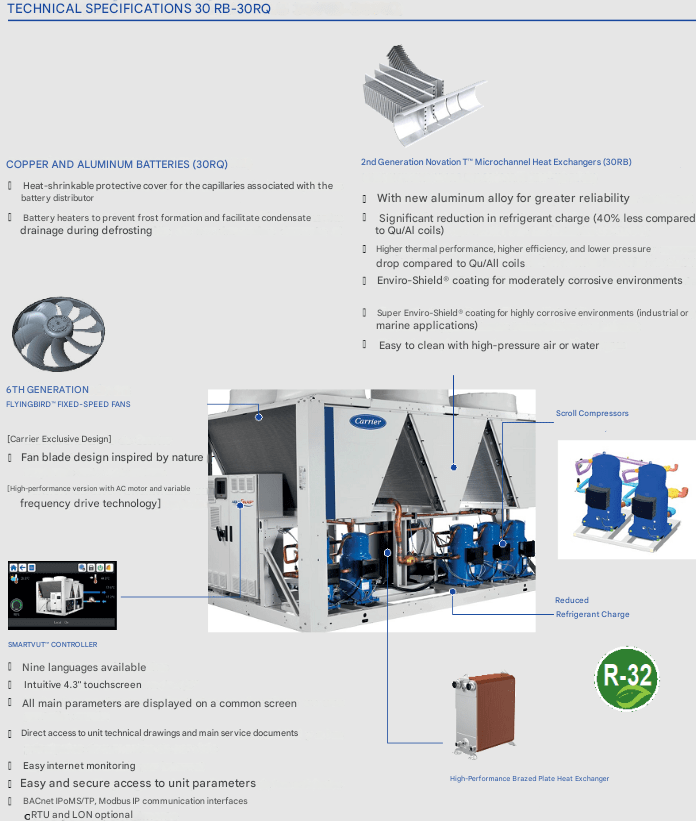
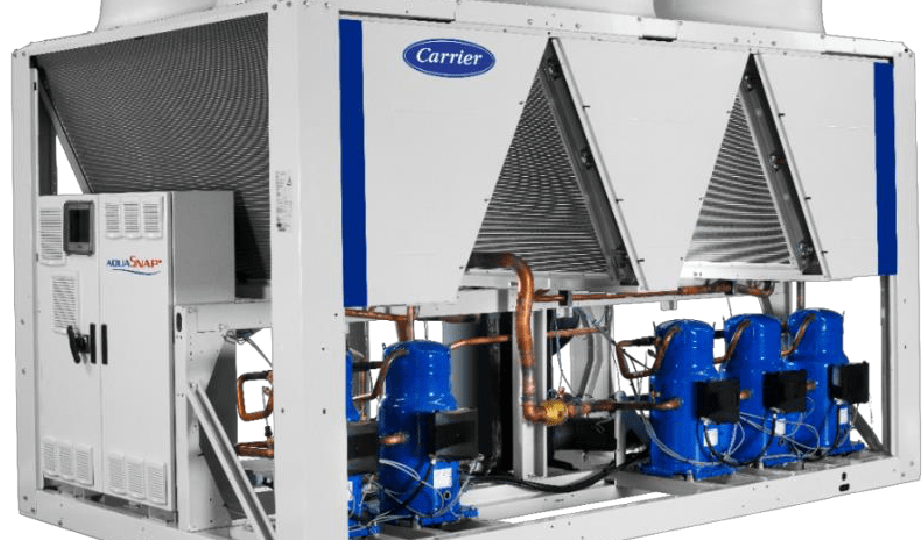
Carrier air-water chiller in which elements that make it up can be seen
- The top is the condensing batteries with their fans
- Compressors (in this case scroll)
- the evaporator where the heat exchange is carried out
- The expansion valve is integrated into the refrigeration circuit.
Energy saving starts from selecting the chiller.
All have optional that can significantly reduce the energy consumed, improves the operation of the machine and extends its useful life.
Some of these optional may be installed later.
- Automatic setpoint reset based on external conditions.
- Free-cooling options based on operation
- Allows the use of outdoor air for cooling with colder outdoor temperatures
- Total or partial recovery of condensation heat
- In a compression refrigerated cycle to produce cold water, heat must be dissipated.
- This heat that is dissipated can be used for the free production of domestic hot water.
- Gateways of communication with the management and control system.
- Allows you to optimize the operation of the machines
- Variation of speed in fans and pumps
- Energy management module
- etc. etc.
Chiller performance in cold production
Performance is the ratio between the energy provided and the energy obtained.
There are technical principles applicable to all chillers, which improve it meaningfully.
Temperature difference between condensation and evaporation
- The energy efficiency increases as the difference between the condensation and evaporation temperature decreases.
- This aspect is very important.
- Example:
- Suppose the outside air is at 32ºC. And the machine is required to provide an energy for example of 200 kWh.
- If a setpoint of 7ºC is established. For cold water production, energy consumption is higher than if a higher setpoint is set (for example 10ºC.)
- Whenever water can be produced at a higher temperature, energy consumption is reduced by increasing performance.
Partial load operation
- When the chiller runs at partial load it increases its performance.
- Chillers are usually made up of refrigerated circuits with various compressors.
- To the same refrigeration circuit they can attack 2 or 3 compressors.
- There is a basic principle of physics that is valid for any pumping:
power=flow*pressure
- Power is a cubic function.
- Flow is a linear function.
- Pressure is a quadratic function.
- If in a refrigeration circuit to which several compressors are connected, only one works:
- A flow of coolant circulates.
- pressure loss occurs.
- Develop a power
- It consumes an energy based on the power developed.
- When a second compressor comes into operation in the same refrigeration circuit:
- The flow is increased
- not double, (but a lower value).
- A greater pressure loss occurs in the circuit as a result of a greater flow through it.
- In that case, to move the same flow provided by a single compressor, greater power is needed due to the increase in pressure.
- Energy consumption increases significantly.
- As energy consumption increases, performance decreases.
- The same would happen in a screw compressor that is capable of regulating the flow it provides.
- As the flow it provides to the refrigeration circuit increases, the pressure rises, decreasing the performance.
- To understand the optimal programming that should be given to the chiller, a chiller with two refrigeration circuits and 5 compressors is taken as an example.
- 2 refrigeration circuits
- Circuit 1: 2 compressors
- Circuit 2: 3 Compressors
- It should be programmed as follows:
- 1 Circuit 2 compressor comes into operation.
- Then 1 Circuit 1 compressor comes into operation.
- The next compressor would be a second compressor of circuit 2.
- From there one of the two circuits would enter 100%.
operation of a chiller
The chillers have internal controls that manage their operation.
In hotels with several chillers, the management of the start-up must be entrusted to the management and control system that is responsible for optimizing its operation.
In this case, the approach is how a single chiller should work.
Previously maintenance has had to fix the slogans:
CONSIGNS
Drive temperature
- It is necessary to tell the chiller at what temperature the water for cooling should produce.
- It should always be programmed in drive because the terminal units (climatizers and fancoils) are calculated based on the temperature at which they receive cold water.
temperature differential
- A differential must be set when the chiller stops to start up again.
night-day
- The energy demand is lower at night as there is no solar radiation and the lowest outdoor temperature.
- Therefore, different setpoints must be set for the impulsion temperature and temperature differential between day and night.
chiller stop march
- It is necessary that there be recirculation of water.
- The chiller needs to be enabled for it to work.
March
- The chiller will try to propel the water to the set temperature.
- If you set for example 9ºC, you will always try to get it out at 9ºC.
- Based on the return temperature and the mass of water, the chiller plant will have to provide the necessary power to achieve it.
- To do this, it is introducing or removing compressors from the refrigeration circuits.
Unemployment
- When only one of the compressors remains in service, if there is not enough energy demand, the water from the chiller will leave less than 9ºC.
Differential temperature stop running
- When the chiller is stopped by its own deactivation techniques when demand is reduced, it is necessary to remain enabled.
- The chiller has to know the temperature of the water that is being provided to the terminal elements (climatizers and fancoils)
- The new commissioning order will be the one that maintenance establishes in setpoint.
- If, for example, 11ºC is set, the machine will start up when the water reaches 11ºC.
- If it is set 14ºC, the chiller will start up when it reaches 14ºC.
- Once the chiller is in operation, the outlet temperature will be set in setpoint. (In example 9ºC.)
night-day
- The cold demand at night is lower than the day.
- The chillers are equipped with the night day function
- This option consists of setting different operating conditions.
- The operation will be exactly the same as the one indicated, although the only thing that varies are the instructions.
- In the example, the outlet temperature of 9ºC has been indicated during the day.
- At night it can be set 11ºC.
- In relation to the temperature differential stop running, something higher can be programmed.
energy needed in the installation
The mission of the chiller in a centralized system is the production of cold water to maintain the enclosures with the required hygrothermal conditions, using it Terminal units (climatizers and fancoils).
The demand for refrigeration in an enclosure is not always the same.
If the sun falls through the windows, if the temperature is high, if there is a high occupation, if there are devices that generate heat, etc. etc., the energy demand will be greater in the face of more favorable conditions such as the absence of sun or lower external temperatures.
A hotel room is taken as an example
- The energy needs of a hotel room are in the most unfavorable conditions of 1,500 W.
- This power is only necessary to contribute a few days a year and at a few hours.
- For example, when the highest incidence of solar radiation occurs on the crystals and the outside temperature is high.
- As the solar incidence is lower and the lower outdoor temperatures, the required power is lower:
The energy contribution of the one terminal unit (Fancoil) will depend on:
- temperature at which the water enters
- water flow
- temperature at which air in the room enters
- Flow of the air moving the fan of the fancoil.
heat exchange occurs
- The air comes out at a lower temperature to cool the room
- The water comes out at a higher temperature because it has given energy to the air
If the fancoil has been calculated so that in the most unfavorable conditions it contributes for example 1,500 W., entering water at 9ºC., as the conditions are more favorable, it will have to provide less energy.
If the water inlet temperature is increased, the energy supply is reduced.
- At 12ºC, the power will be lower.
- At 14ºC, the power will be even lower.
- It is what the room requires at all times.
Optimization of energy consumption in the installation
In previous sections, techniques that correctly implemented reduce energy consumption have been analyzed.
A good energy optimization begins in the design of the system, in the selection of optional machines and elements and once executed, as is the case that we are considering, establishing adequate operating conditions.
Part-load chiller operation
It has been previously analyzed and the causes that reduce energy consumption and improve performance have been exposed.
- It is programmed through its own control.
- Based on the number of compressors and refrigeration circuits, their input and output sequences are established.
Water distribution at higher temperature
In a compression cycle, as the temperature difference between condensation and evaporation of the refrigerant is reduced, the yield increases, both to partial charge and to full charge.
Increasing the water temperature not only represents a lower energy consumption in the chiller itself, but also in the installation.
- Latent heat losses in the terminal units are reduced.
- The water vapor content in the air depends on the air temperature.
- At a lower temperature, the air admits less water vapor, condensing into the battery of the terminal unit, exactly the same as it happens with the air that comes into contact with a glass of cold beer and forms water droplets on its surface.
- In that change of state, energy is consumed.
- With water at a higher temperature, condensation and energy consumption are reduced.
- Transmission losses are reduced through the isolation of hydraulic distribution networks
- Cold water must be carried through a network of pipes to the terminal units.
- The energy losses depend on the temperature of the fluid (in this case cold water) and the outside temperature.
- As the water has a lower temperature, energy losses increase.
Comfort is increased.
- Whenever the air is brought to the room at a temperature closer to the room temperature, comfort is improved.
- In a hotel room, a colder air vein would come out through the grid, which is undoubtedly more annoying than if it comes out at a higher temperature.
- On the other hand, if the fancoil gives a greater power to receive colder water, the thermostat detects before it has reached the setpoint temperature and starts and stops are more frequent.
chiller running stop
Every time a chiller is started there is an energy loss caused by the need to move from the resting state to its nominal speed.
Therefore, it is convenient to optimize the number of starts and stops.
As indicated above, the machine stops when the outlet temperature is equal to or somewhat lower than that of the setpoint, because the energy demand in the installation is reduced.
If the machine produces water at 9ºC. and a very low differential is established, for example 1ºC., when the circuit detects that the water is propelled at 10ºC., it starts the chiller again.
If instead of 1ºC, it is fixed for example 3ºC. It would enter when 12ºC is detected, thereby reducing the start and stop number.
- As the differential is widened, energy consumption is reduced and performance increases.
- The operation of the machine is improved
- Faults are reduced
- Shelf life is increased.
Operation of the pump group associated with the chiller
It is observed in many installations that the pumps associated with the chillers work continuously, 24 hours when they are in service.
The reason is because the chiller must detect the temperature of the water that passes through it to get back on track after a stop.
This aspect is easily solvable by placing a thermostat on the secondary circuit drive (the one that distributes to terminal units that always has to be in service).
In that case:
- When the chiller stops, its pump associated with a small delay is disconnected.
- When in the drive of the secondary circuit it is detected that the temperature of the water reaches the set set value (for example 12ºC.), starts the pump again and the chiller shortly after.
Disconnecting the pump when not necessary assumes:
- significant energy savings.
- A greater durability of the pump itself and the elements through which water circulates continuously and unnecessarily.
Stop the chiller when disconnecting the secondary circuits
It is observed that in some installations there is no relationship between the operation of the secondary circuits (climatizers and fancoils) with the chiller.
The purpose of a chiller to work is to provide cold water to the terminal units.
If the terminal units are disconnected, there is no purpose for the chiller to remain enabled.
- When the pumps that serve the secondary circuits corresponding to terminal units are disconnected, the cooler and the associated pump group must be disconnected.
- When any of the secondary circuits are re-enabled, the associated pump group and the chiller would also be enabled.
Disconnecting the chiller with low outdoor temperatures
Sometimes and especially at night in spring and autumn, outdoor temperatures even drop to values much lower than those required to refrigerate.
In this case, it is convenient to proceed to disconnect the chiller and secondary circuits from a value that can be set in setpoint:
- If, for example, the outside temperature drops to 18ºC, it is not necessary for the chiller to work, unless there is a special event that requires it.
- At that time, the disconnection order would be given to the chiller and pumps of the secondary circuits.
- When the outside temperature rises again and reaches (for example 21ºC.) the chiller and the secondary circuits that serve the terminal units are activated.
night-day
The night day option usually comes as standard on all machines.
- Some slogans are set for the day operation.
- cold production temperature
- temperature differential so that the chiller enters after a disconnection.
- The time in which the day night is switched is set
- A set of instructions are set for night operation.
- Cold production temperature (something higher than the daylight)
- temperature differential so that the chiller enters after a disconnection. (something higher than the day)
Drive temperature using the outside temperature as reference
This function there are machines that bring it as standard and others that allow its implementation as optional.
The conditions throughout the day are changing.
The outside temperatures are not the same at 9 in the morning, at 2 in the afternoon or at 9 at night.
Therefore, if a drive temperature is set in the chiller, it is done taking into account the maintenance of the comfort parameters and it is not logical that the maintainer changes the water outlet setpoint in the chiller continuously throughout the day.
For this reason, it is advisable to implement an option that completely automatically changes the setpoint temperature and, based on it, the rest of the instructions that affect the cold production as the differential so that the chiller comes into operation after a stoppage.
In this way, as the outdoor temperature increases, water at a lower temperature is produced and as the outdoor temperature decreases, water at a higher temperature is produced, establishing a ramp for operation.
Example
- If with an outside temperature of 33ºC, the water leaves at 9ºC.
- With an outside temperature of 25ºC, the water can leave at 12ºC.
- The higher the evaporator outlet temperature, the less energy is consumed.
- The differential is set after the stop.
- If, for example, the setpoint is set so that the chiller will work again when there is a differential of 3ºC.
- When disconnecting at 9ºC, the machine will start again when the temperature on the drive is (9+3=12ºC.)
- When disconnecting at 11.5ºC, the machine will start again when the temperature on the drive is (11.5+3 = 14.5ºC.)
- Different conditions must be established for the night.
Impact of maintenance on comfort and sustainability
To reduce energy consumption, the number of breakdowns and lengthen the useful life of machinery, elements and equipment, adequate maintenance is required by qualified professionals.
As the thermal installations demand the highest energy consumption in the hotel facilities, the RITE (Thermal Installations Regulations) establishes mandatory requirements in its maintenance.
Maintenance must be carried out by authorized companies and all actions must be documented.
It is necessary to analyze and establish slogans that optimize the operation.
Inadequate instructions greatly increase energy consumption.
An air-water cooling plant is exposed to atmospheric incidents.
In condensation batteries, through which a fairly high outside air flow is passed, impurities are deposited that cause a decrease in the air flow required to condense the refrigerant.
- The energy consumption in the fans is increased.
- The condensation pressure is increased.
- As a result of higher pressure, the energy consumption of compressors.
- If you reach the maximum limit of the pressure switch installed by the manufacturer, disconnect the machine (high jump).
- The refrigerant pressure is high, so breaks with gas leaks usually occur.
- Faults are increased.
- decreases the life of the machine.
- It leaves customers without service at the most unfavorable moments.
There may also be incidents in the evaporation batteries, if the water provided has some impurities and the filtration elements are not clean.
The RITE requires that these cleanings be carried out on a quarterly basis.
In addition, it is necessary to carry out filter cleanings, revisions of the exchange systems, of pumps, control, etc. etc., with monthly, quarterly, semi-annual and annual frequencies.
All this is specified in Table 3.3 of IT 3.3 of the RITE.
Good maintenance ensures the correct operation of the chiller, improving comfort, reducing energy consumption, avoiding the appearance of breakdowns, increasing the useful life of the machine, elements and equipment and making the installation more sustainable.
Conclusions
- This article analyzes the energy optimization in the production of refrigeration, considering it individualized with the control of the machine.
- Refrigeration production usually represents the greatest energy consumption in hotel facilities.
- The refrigeration cycle is analyzed based on an air-water chiller, which are installed in most hotels.
- The most important conclusions are the following:
- The facilities are calculated for the most unfavorable operation.
- Refrigeration needs are highly variable throughout the day, month and year.
- A terminal unit (climatizer or fancoil) has to develop its maximum power only in specific periods.
- The rest of the time the power to provide is less than or much lower than nominal.
- Increasing the water inlet temperature in a terminal unit (climatizer or fancoil) its power is reduced.
- consumes less energy.
- provides greater comfort.
- The energy consumption of a chiller plant is reduced:
- producing water at a higher temperature.
- working at partial load.
- The energy consumption demanded by a facility decreases if the water is distributed to the terminal units at a higher temperature:
- Latent heat in the terminal units is reduced.
- The losses in the distribution are lower as there is less temperature difference between cold water and the environment.
- It is necessary to reduce the start and stop number of the chiller
- energy consumption is reduced.
- The potential risk of breakdowns is reduced.
- The useful life of machinery elements and equipment is increased.
- It is necessary to activate the night-day function in the chillers and carry out a correct regulation.
- The temperature of the water that is sent to terminal units is increased at night.
- The start and stop differential increases at night.
- It is necessary to prevent the operation of the pump group associated with the chiller
- It is observed in many installations 24-hour operation.
- It should only work for the necessary time.
- There must be a coordination between the operation of the chiller and the distribution circuits to terminal units.
- Circuits to terminal units are always in operation.
- When the pump groups are disconnected from these circuits, the chiller must be disconnected.
- When one of them is reconnected, the chiller must be enabled.
- The chiller and secondary circuit pumps must be deactivated for low outdoor temperatures.
- If the outside temperature is low, it is not required to produce refrigeration (except for exceptional cases of a specific event).
- If the outside temperature is increased, chillers and pumps will also be activated.
- It is advisable to implement a cold production system that has the outside temperature as a reference.
- Increase or decrease the water outlet temperature, optimizing energy consumption continuously.
- It is very important to establish adequate slogans.
- Inadequate slogans increase energy consumption and damage the installation.
- Thermal installations require that they are served by qualified technicians who know the techniques applicable to them.
- The RITE (Regulation of Thermal Installations requires preventive maintenance carried out by qualified companies that have to be perfectly documented.
- Good preventive maintenance reduces energy consumption, prevents breakdowns and increases comfort
- We Resolve as a company of integral maintenance of unique buildings, with extensive experience and implementation in the hotel sector (in Spain and America), has a technical department in which the pathologies, optimization and improvements that occur in the field of facilities are analyzed.
- In the case of refrigeration production, which usually represents the greater energy consumption of hotel facilities, any improvement represents a significant reduction in production costs, increasing sustainability and reducing environmental impact.
- It is advisable to carry out in the hotel facilities, energy audits in the refrigeration facilities, which allow providing solutions to optimize energy consumption, increase comfort, reduce the risk of breakdowns and extend the life of machines, elements and equipment.
Literature
THERMAL INSTALLATION REGULATION
https://www.miteco.gob.es/es/energia/eficiencia/rite.html
Carrier Technical Catalogs
https://www.carrier.com/commercial/en/es/solutions/coolers/coolers-air-water/30rb—30rbp/
3/03/2025
José Arroyo Martín
Ingeniero Tecnico Industrial en Electricidad y Mecánica