

Initial clarifications
1
This article is about giving an insight into electrical circuits and receivers, typical of hotel facilities.
Technical documentation and freely available graphics are used on the Internet, always indicating its origin.
Complementary bibliography is attached that allows to expand knowledge of the concepts specified here.
electrical networks.
1
The electrical networks that are used not only in hotel facilities, but also in homes and industries are alternating current.
Electrons continuously change direction and oscillations occur between current and voltage.
The positive pole becomes negative and vice versa in a very short period of time.
The number of times the cycle changes in a second is called the frequency.
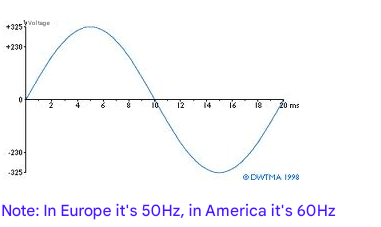
230 V. is the effective value of single-phase voltage in Spain
https://www.areatechnology.com/electricidad/circuitos-de-corriente-alterna.html
receivers.
1
Receivers used in hotel facilities are of various types.
Pure resistors: (example electric kitchen griddle)
reactances &nb . sp; (example coils of an electric motor)
capacitors   . ; (power factor correction)
Receivers with non-linear loads (example electronic equipment)
Types of receivers in electrical networks.
1
Basically, 4 types of receptors can be considered:
- resistive
- Inductive
- capacitive
- nonlinear loads
If a receiver is connected to a sinusoidal AC electrical network, its behavior is as follows:
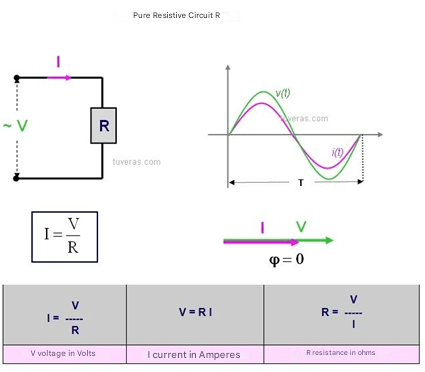
pure resistive circuit
- The applied voltage and the current circulating through the receivers are in phase and have sinusoidal components of the same frequency.
- When the instantaneous voltage is maximum, the current is maximum.
- When the instant voltage is 0, the current is 0.
https://www.areatechnology.com/electricidad/circuitos-de-corriente-alterna.html
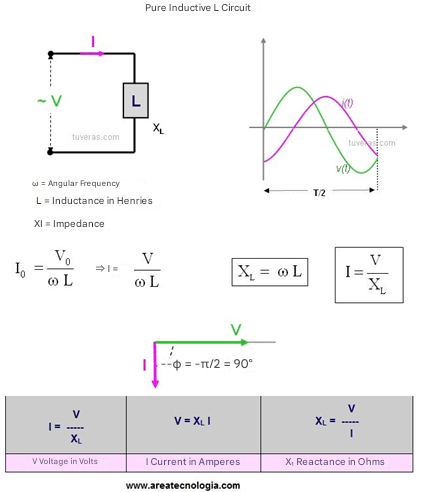
Pure inductive circuit
- For its explanation, the ohmic resistance offered by the cables is not considered and only the effect caused by the coil.
- The sine wave is not distorted either in voltage or current.
- Passing the current through the coil causes an electrical flow that causes a lag between the applied voltage and current.
- The sinusoidal component of the current is 90º delayed in delay, with respect to that of the applied voltage.
- When the instantaneous voltage is maximum, the current is 0.
- When the instantaneous voltage is 0, the current is maximum.
https://www.areatechnology.com/electricidad/circuitos-de-corriente-alterna.html
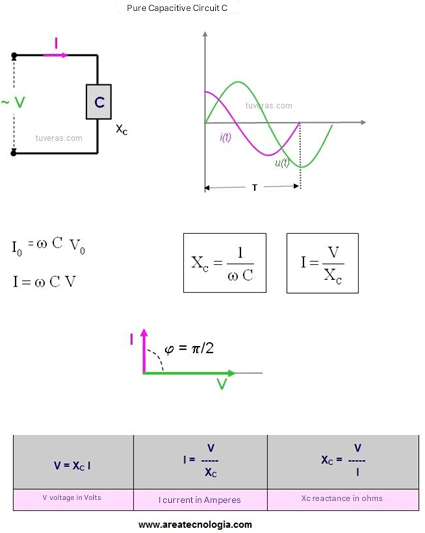
pure capacitive circuit
- For its explanation, the ohmic resistance offered by the cables is not considered and only the effect caused by the capacitors.
- The sine wave is not distorted either in voltage or current.
- Passing the current through the capacitor causes a shift between the applied voltage and current.
- The sinusoidal component of the current is 90º in advance with respect to that of the applied voltage.
- When the instantaneous voltage is maximum, the current is 0.
- When the instantaneous voltage is 0, the current is maximum.
https://www.areatechnology.com/electricidad/circuitos-de-corriente-alterna.html
Circuit with nonlinear loads
- They are those that cause disturbances in the electrical network.
- As a consequence of these disturbances the wave ceases to be sinusoidal.
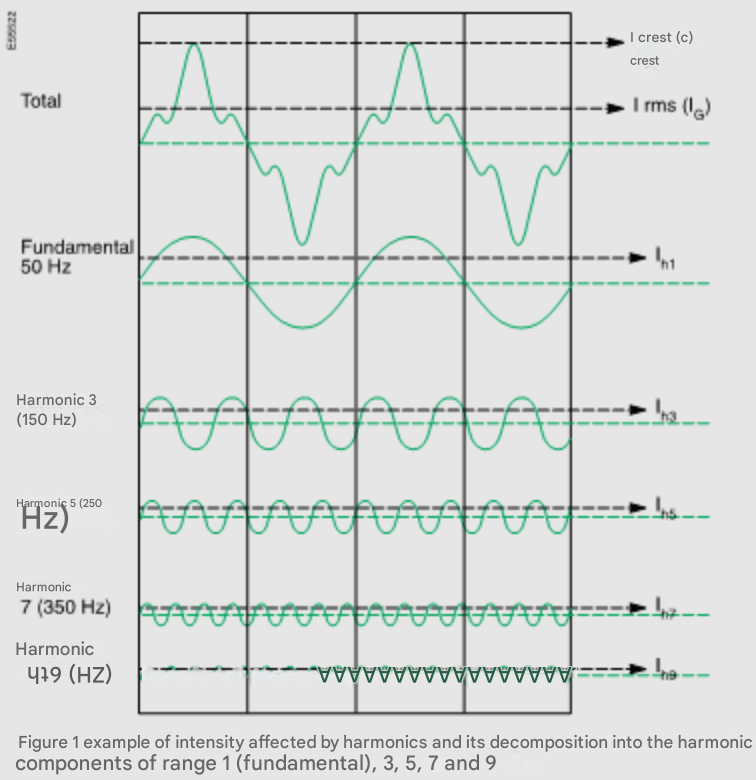
- Distortions caused by receptors are called harmonics.
- Harmonics are non-sinusoidal periodic functions.
- The Fourier theorem indicates that any non-sine periodic function can be represented as:
- a sinusoidal term that is the fundamental frequency
- harmonic sinusoidal terms
http://automata.cps.unizar.es/bibliotecaschneider/bt/guia/5_armonicos
At the top of the graph Real wave caused by the receiver
Next, the fundamental (in Europe 50 Hz.)
Then the decomposition according to Fourier in harmonics of order 3,5,7,9
Basics
1
In any electrical installation, the ideal is that the voltage and the current go in phase, with which the powers of generators and transformers are fully used.
Each receiver is manufactured for a power.
Power = Voltage * Current
Power is the work developed in the unit of time.
Energy = Power * Time
The cables offer resistance to the passage of electrical current. (R)
When the electrical current circulates through the cables, (i) losses occur due to Joule effect.
Power lost in the cable = V * i = (i * r) * i = r * i^2
These power losses in the cables are transformed into heat.
It is important to note that they are proportional to the square of the intensity.
In resistive receptors (pure ohmic resistance), all the intensity that circulates through the cable is necessary to produce work and therefore the energy losses in the cable are minimal.
In receivers equipped with coils such as motors, the intensity that circulates along the line is greater than that required by the receiver to develop its active power.
Therefore, the energy losses in the lines are higher than those strictly necessary.
The same thing happens in a capacitive circuit. Although capacitors are used in electrical networks to improve the power factor.
As with inductive currents, in circuits with non-linear loads, harmonics cause an increase in circulating intensity and an increase in power loss due to joule effect, with a series of complementary aggravating factors due to harmonic distortions, which cause deficiencies in the operation of the installation.
conclusion
1
In an electrical installation there are various types of receivers.
Except for those that are pure ohmic resistances, they all create a disturbance in the electrical network.
The disturbances basically cause a greater intensity than necessary to circulate through the circuits.
In the case of receivers that in their operation give rise to non-linear loads, in addition to increases in circulating currents, they generate harmonics that create complementary distortions that affect the normal operation of the installation.
Literature
1
Technology area.com
https://www.areatechnology.com/electricidad/circuitos-de-corriente-alterna.html
Harmonic Detection and Filtering (Schneider)
http://automata.cps.unizar.es/bibliotecaschneider/bt/guia/5_armonicos
Videos
1
the electric current
5/06/2024
José Arroyo Martín
Ingeniero Tecnico Industrial en Electricidad y Mecánica