

Introduction.
1
Water is a scarce good, necessary for life on earth.
Climate change causes the appearance of long periods of drought, which forces us to correctly manage the available water and make the most of water resources.
From the point of capture to the point of use, a long process is developed, which requires significant energy consumption, both in potabilization and in distribution, carried out in part with non-renewable energies obtained from fossil fuels, which increase global warming of the planet.
In many of the existing networks there are losses due to poor execution, their obsolescence or improper maintenance.
In addition to an ecological awareness work towards the clients and the staff of the hotel, it is necessary to implement optimization techniques to reduce consumption.
In this article, water savings in hotel facilities will be analyzed, using existing techniques and reuse availability.
As we are able to save, more water will be available and the environmental impact will be reduced sensitively.
Water consumption in hotel facilities.
1
In a hotel facility, water consumption is relatively high.
These consumptions take place in:
- Rooms
- common areas
- Kitchen
- Coffee shops
- laundries
- Swimming pools
- Spas
- IRRIGATIONS
- ornamental sources
- cooling towers
- etc.
There are additional consumptions in some treatments.
- decalcification
- Depuration
- Osmotization
Drinking water is consumed in many processes in which water from other origins can be used
- Cisterns
- Fluxors
- Filled with pools
- IRRIGATIONS
- ornamental sources
- etc.
regulatory requirements in relation to saving water.
1
Water savings are always accompanied by energy savings and an improvement in comfort.
Plumbing facilities are included in:
- CTE (Technical Building Code) Basic Document HS Health, Section HS 4. (DB-HS4)
- Other complementary regulations
- CTE (Technical Building Code) Basic Document HS Health, Section HS 5 Sanitation (collection of rainwater, gray water for recycling and other uses)
- RITE (Thermal Installation Regulations) in relation to the production of domestic hot water.
- Swimming pools (normally developed at the autonomous community level)
Regarding water savings
DB-HS4
2.3 Water saving
- An accounting system of both cold water and hot water must be provided for each individualizable consumption unit.
- In the DHW networks, a return network must be provided when the length of the pipe from the one way to the farthest point of consumption is equal to or greater than 15 m.
- In the public concurrency areas of the buildings, the taps of the sinks and the tanks must be equipped with water-saving devices.
3.6 Water saving
- All buildings in whose use the public attendance is foreseen must have water-saving devices in the taps. The devices that can be installed for this purpose are: faucets with aerators, thermostatic taps, faucets with infrared sensors, faucets with a timer push-button, fluxors and adjustment keys before the points of consumption.
- Equipment that uses water for human consumption in condensation of refrigeration agents must be equipped with water recovery systems.
Regarding the pressure
DB-HS4
2.1.3 Minimum supply conditions
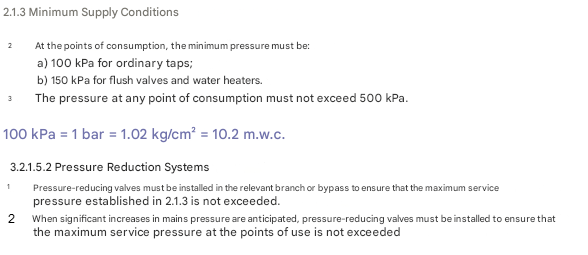
incidence of pressure on water savings.
1
Pressure regulation is the technique on which devices used to reduce water consumption are based.
The regulatory requirements include:
- Setting a minimum pressure for correct operation.
- Maximum pressure limitation.
There is a relationship between the pressure that reaches a tap and the water that comes out of it.
This relationship is:

in which:
Q: water flow
K: constant that depends on the type of water outlet
P: Pressure
It will be seen with an example:
The tap of a sink at the pressure of 1 bar provides a flow rate of 6 liters/minute.
Suppose that at that time the faucet is fully open
What is the flow rate if the pressure is 4 bar?
At the pressure of 1 bar it provides:

*Liters/minute
It is easy to determine the K of this faucet when it is fully open.

If the pressure is 4 bar

Through a tap that at the pressure of 1 bar comes a flow of 6 liters/minute, when the pressure increases to 4 bar it provides double (12 liters/minute)
If you take into account the maximum pressure supported by the DB-HS4, it is 5 bar.

at pressure is 5 bar, (maximum allowed) would come out of the tap 13.42 liters/minute
Therefore, the consumption of water in a sink, in a bidet or in a shower can be greater than twice that necessary.
Also indicate that the constant k of each element will depend on its degree of aperture.
If that faucet doesn’t turn off, we regulate the flow. In that case we are reducing the passage of water, creating a pressure loss and modifying the coefficient K which is different for each degree of opening.
Excessive pressure at the outlet of a faucet is also annoying.
All the elements that are used as saving devices in sanitary devices are based on causing a loss of pressure, to reduce the flow.
Water savings are always accompanied by energy savings and an improvement in comfort.
pressure regulation.
1
Given the incidence of the pressure on water consumption, it is necessary to look for elements that reduce it to the minimum necessary.
Normally in the hotel facilities, cisterns and pressure groups are installed, although there may be areas that are directly attended by network pressure.
Mains pressure greater than 5 bar
Since the maximum pressure limit at any point in the installation is 5 bar, if the network is connected to a distribution network and at some point terminal there is more than 5 bar, a reduction device must be installed.
For this, pressure reducing valves are used, which have a mechanism that regulates the outlet pressure.
Regardless of the pressure it receives, it is always reduced, so that it comes out at a preset pressure.
If the mains water reaches a cistern directly, it is not necessary. (The cistern is filled before, although there is no direct consumption of water).
high building
Pressure for the most unfavorable point greater than 5 bar
- It is necessary to install two pressure groups
- one for ground floors
- another for tall plants
It is not correct to install a pressure group with reducing valves, because the energy consumption of the pump groups would be very high.
The power provided by a pump group is proportional to the flow and pressure:

*Potency = Caudal * Pressure
Flow is a linear function.
Pressure is a quadratic function.
Power is a cubic function.
If a pressure group is installed, prepared to raise water to high altitudes and pressure reducing valves are installed, the power consumed is much higher than that required, because the pump provides the required flow at a high pressure, which is then reduced by the action of the Reducing valve.
Therefore, in buildings where with a pressure group it is necessary to provide more than 5 bar, which is the limit allowed by the regulations, it is necessary to install two pressure groups.
How to save water in hotel facilities.
1
The technique offers a series of tools that allow effective water savings.
Some cases are indicated.
Techniques based on pressure reduction
- If the outlet pressure is reduced by a tap, the flow is reduced.
- This technique is based on devices that are installed on devices:
- showers
- sinks
- Bidets
- Bar and kitchen sinks
- Fluxors
- IRRIGATIONS
Techniques based on water optimization
- Adjust the flow rate in the tanks
- Adjust the flow rate in the fluxors
- Faucet timing
- Selection of washing equipment with better water use
- Selection of filters in more efficient pools, which require less water in the wash
- Selection of decalcifier equipment that requires less water in the washing of the resin bed
- more efficient washing machines
- More efficient dishwasher
Techniques based on the implementation of complementary measures
- Limit pool evaporation
- Adjust the risks to hours of less evaporation
- Modify irrigation techniques
Techniques based on measurements and proper maintenance
- Cistern drips
- Leaks in closed circuits of thermal installations
- Pool leaks
- Leaks in the distribution network
- Periodic verification of pressures
Water contributions in a hotel facility.
1
The main contribution of water is the sanitary water distribution network.
In some areas there are networks of recycled water.
However, in a hotel there are many uses in which water from other sources can be used.
- Obtaining water by recycling gray water.
- Rainwater
- Condensing water corresponding to the air conditioning facility.
- Condensing water corresponding to refrigeration machines.
- purge water in cooling towers.
- water of the water table
- Well water
- Accumulator purges
- Emptying of installations
- Drains Valves Safety
- possible use of other waters that are dumped into the network
Water treatments for hotel facilities.
1
The water that is normally used in the hotel facilities is drinking water from the distribution network.
Increasingly, water companies apply treatments that improve their quality and reduce hardness.
In many cities, as may be the case in Malaga, the water that historically had a high hardness has dropped considerably due to the treatment of purification.
On its website EMASA indicates the following:
Thanks to the treatment of reverse osmosis in the purification process Since 2006, we have substantially reduced the hardness of the water we supply to Malaga households. This hardness is around 100 mg/l (about 80 mg/L calcium hardness).
Water hardness classification
On the Junkers-Bosch website, it is indicated:
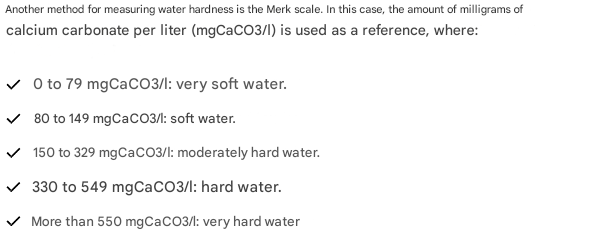
https://www.junkers-bosch.es/knowledge/advisors/como-mide-dureza-water/
On this same page, a homemade trick is offered to determine quickly whether or not the water is hard:
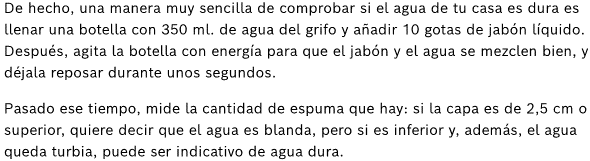
https://www.junkers-bosch.es/knowledge/advisors/como-mide-dureza-water/
How to know if the water is hard?
It must appear on the website of the supplying company or on that of the City Council.
For example in Malaga:
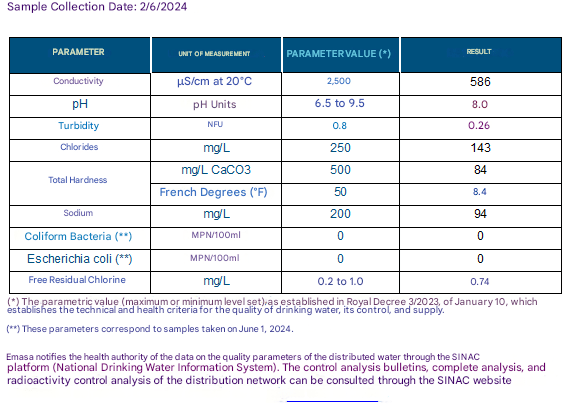
It is observed that that day the result is 8.4ºF, which is soft water (very close to very soft) and does not require any treatment.
In the following link corresponding to the SINAC page (National Information System for Water for Consumption), you can know the characteristics of the water of any municipality.
https://sinac.sanidad.gob.es/ciudadanoweb/ciudadano/informacionbastecimientoacionentrada.do
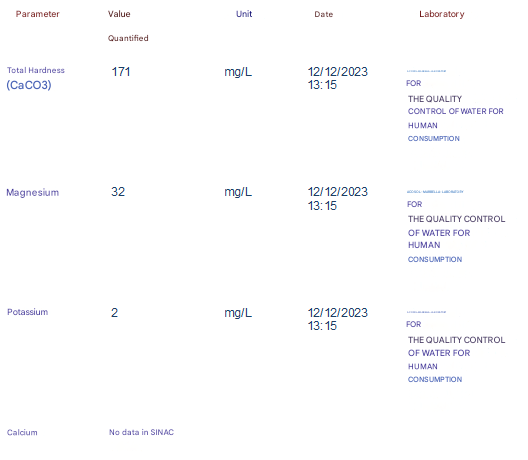
SINAC MARBELLA
It is a semi-hard water of very good quality, very close to the soft (17.1ºF, somewhat higher than 14.9ºF. which is the limit of the soft one)
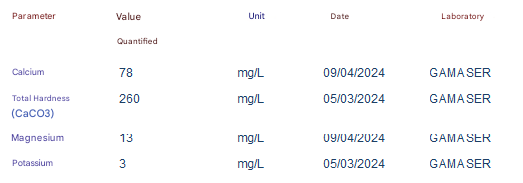
Sinac Conil
It is a semi-hard water (26ºF)
If it does not appear on the website of the water company or the SINAC, carrying out an analysis of the hardness of the water is very economical.
decalcification
Water usually carries calcium and magnesium ions in its composition.
When the concentration is high, the water is considered hard.
Water hardness is usually measured in French degrees (ºF), equivalent to 10 milligrams of calcium carbonate per liter.
That the water is hard, does not mean that it is not drinkable and can be consumed without any problem, although it creates a series of effects that must be corrected in the hotel facilities.
These effects are:
- Reduction of the useful section of the tubes due to calcareous precipitation in its walls and accessories.
- Reduction of heat exchange when deposited on the exchanger surface.
- Reduction of equipment life.
- others.
Decalcification consists of replacing sodium ions with calcium and magnesium in a bed of resin.
It requires frequently washing the resin bed and for this, water, sodium chloride and energy are consumed.
osmosis
It is a purification treatment that requires high energy consumption and in which significant water losses occur.
In some hotels a small facility is installed for specific treatments.
physical procedures
They do not affect the composition of the water, but passing through a magnetic or electrostatic field changes the polarity of the calcium and magnesium salts, preventing it from being deposited in pipes and exchange elements.
The effect is limited in time and in a more or less long period of time, the water recovers its initial properties.
There are devices on the market that do not have a proven operation.
Any system that is installed must be supported by laboratory tests and analyzed by engineering.
Are these treatments necessary?
Possibly not.
None required for soft water.
For semi-hard and hard water, other parameters would have to be analyzed and it could only be necessary in hot water, where precipitation of calcium and magnesium occurs due to the effect of heat.
Some inertia and trends are observed that come from the past, generally installing softeners in places where they are not precise:
- One trend was to install softener for hot and cold water
- Possibly in some cases, for cold water it would never have been necessary.
It is highly recommended to analyze the need to descale and if only this need is for domestic hot water.
If the treatments are optimized, the water consumption that is accurate for washing resin beds, as well as the consumption of salt and energy, can be significantly reduced.
It is advisable to analyze the current treatment systems, due to possible improvements that there have been improvements in the quality of the waters and where necessary, it has ceased to be.
Design hotel facilities.
1
In the design of the hotel facilities, it is necessary to take into account all the parameters available for the optimization and use of water.
Likewise, when a reform is proposed, it is necessary to address what can be done to save water.
You have to forget about a network for everything.
In rooms and common areas, drinking water is necessary for showers, sinks and bidets, but not for toilets.
Therefore, two independent networks must be proposed:
- Drinking water distribution networks.
- toilet distribution networks.
Another aspect to consider is the height of the building.
- In tall buildings you have to subdivide the facilities:
- Areas served with network pressure
- pressure group ground floors
- Pressure group Tall plants
With regard to sanitation networks, it is not enough to separate rainwater and fecals:
The correct solution is:
- fecals
- Evacuation to general sanitation network
- gray waters
- reusable through treatments
- Can be used for watering, cleaning.
- reusable through treatments
- Storms and clean water
- Rainwater collection
- Use condensation fancoils and air conditioners.
- Condensation use cold storage.
- Purged cooling towers.
- installation emptying.
- Purge use
- The decree against Legionella demands purges in hot and cold water, which represents a fairly significant loss of water.
- in accumulators
- at installation points
- in terminal units
- The decree against Legionella demands purges in hot and cold water, which represents a fairly significant loss of water.
Gardening.
1
In gardening you can use recycled water. In some areas there are distribution networks.
It is possible to reduce the consumption of drinking water in gardening by using
- Rainwater
- recycled waters
- Well waters
- waters of the water table
- water from uses in the installation.
- Swimming pool shower waters.
also applying the most adequate and economical irrigation techniques
- Aspersion
- Drip
- Exudation
Automating irrigation to select the hours.
- As long as it can be irrigated at night, evaporation is much lower and less water is required.
- Analyze the need for irrigation through humidity sensors.
Pools.
1
It must be analyzed if there is water with the technical characteristics that allow the necessary treatment to fill the pools with the necessary treatment.
- Well water
- Rainwater
- water table
A large amount of water is consumed in the pool.
- Filter washes
- There are efficient filters that reduce the consumption of washing water
- Optimize washing time
- Evaporation
- Significant losses occur in swimming pools by evaporation.
- Sometimes pools have irregular shapes that do not allow them to be completely covered.
- If 100% is not covered, just evaporate the small part that remains uncovered.
- In hot water pools, evaporation intensifies as its temperature is greater, increasing the amount of water that must be replenished.
- Evaporation occurs at the cost of the internal heat of the pool’s water mass, causing a cooling of all the water contained in it.
- This aspect is essentially serious in heated pools, which require a large amount of energy, not only to heat the replacement water, but fundamentally due to the cooling caused by evaporation.
seawater pools
- One aspect that is being raised with the drought is the filling of swimming pools with seawater.
- It will be necessary to study the possibility of its implementation at all times.
Pool showers
An important consumption in pools occurs in showers.
- The swimming pools are usually located in the garden area, which are the lowest levels and therefore the showers are subjected to greater pressure.
- Water consumption is higher than necessary.
- It is necessary to take measures to reduce the pressure that reaches the shower area, by means of pressure reducing valves that significantly reduce consumption.
- On the other hand, you also have to install timers to prevent the shower from being open.
Use of shower water
- The water used in showers is drinking water and since it does not have the chemical components of pool water, it allows it to be recycled.
What is recommended?
- Cover the water surface with floating sheets to prevent evaporation and cooling.
- Covering the pool reduces the consumption of water, chemicals for treatment and energy.
- When a pool is irregular in shape and is problematic, cover as much as possible.
- Install pressure reducing valves in the shower network.
- Install timers in showers.
- Collection of shower water for recycling
- Irrigation
- Cleaning
Optimization consumption in rooms and common areas.
1
Consumption in rooms and common areas in hotel facilities is high.
The toilets with a higher consumption are toilets and showers.
The toilets can be perfectly filled with rainwater, of the water table, recovered from the purges of installations or recycled, being essential that they have a network independent of the rest of the toilets.
Reduction of toilets consumption
- Installation of double discharge tank mechanisms.
- reduced 3 liters
- Total 6 liters
- There are toilets that can work with 2 liter tanks in reduced and 4 liters in total discharge.
showers
- Installation of pressure reducers in the section between taps and showers
- It should be analyzed where they are installed
- It is not necessary in tall plants where the water reaches less pressure.
sinks
- aerators
- reduce pressure and therefore flow
- Mix water and air and reduce consumption provide more comfort
- They are of various types, being able to incorporate into their pressure reducing mechanism.
- Devices with infrared sensors for faucet opening and closing
Bidets
- aerators
- reduce pressure and therefore flow
- Mix water and air
Services in common areas
- In hotels there are a number of services in common areas.
- They are usually in the ground floor and basement, where the water pressure is higher and therefore the consumption per device is higher.
- In these cases it is necessary:
- toilets
- Always with water for use (water table, well, rain, from purges, recycled, etc.)
- If it is with double tank optimization mechanism (3-6 liters) or (2-4 liters)
- If it is with fluxor, adjust regulations
- Always with water for use (water table, well, rain, from purges, recycled, etc.)
- sinks
- Timed faucets
- Preferably with infrared sensors.
- As soon as it does not detect the need, it cuts the water.
- All faucets with aerators
- As the pressure is higher than that necessary, install pressure reducing elements.
- Preferably with infrared sensors.
- Timed faucets
- urinals
- Timed Fluxors
- showers
- Thermostatic taps.
- They must be equipped with pressure reducing elements to optimize the flow.
- Sinks Bars and Kitchens
- Timed faucets or foot buttons.
- They must be equipped with pressure reducing elements to decrease the flow.
- toilets
Filling of installations closed circuits
- In hotels there are a series of closed circuits in which it is not necessary to provide water. It should always have the same water as the initial filling.
- However, it is observed that due to deficiencies in the installation or due to breakdowns, water sometimes comes out of safety valves or there are undetectable leaks.
- A water consumption is associated with an important pathology that negatively affects the installation.
- In these cases, counters that trigger alarms when consumption occurs in these circuits is essential.
COUNTERS
- To know and control consumption it is necessary to measure.
- At the level of autonomous communities, the Junta de Andalucía contemplates agreements with the hotel sector in relation to accountants.

News Aparecida Correo Andalucía 26-2-24
- There are also services that existing a control can optimize the water and at the same time detect any leaks that appear:
- Filling of facilities
- Refrigeration
- Heating
- Solar
- RECOVERY COOLING PLANTS
- Bars
- Do you cook
- Swimming pools
- laundries
- Spas
- gyms
- Rooms
- etc.
- Filling of facilities
- It is necessary to monitor consumption and establish alarms that detect irregularities.
- Example if water supply is verified in a closed circuit.
- If consumption exceeds a set limit.
pressure groups.
1
The distribution of water in hotels is generally carried out by means of pressure groups.
There are two types of pressure group.
conventional
The most outdated that provide water to the installation between two pressures (maximum and minimum).
Example
Suppose an existing installation with a pressure group that works between 4 and 6 bar.
- The installation needs to function correctly that the pressure is 4 bar.
- However, the pressure received by the terminal units will be variable between 4 and 6 bar.
What are the consequences?
- water consumption is increased.
- If a faucet receives the water at higher pressure, a higher flow exits through it,
- They will only provide the expected flow if they have pressure limiting elements.
- In the moments that exceed 5 bar they do not meet the specifications of the DB-SI4
- If it is regulated with a lower pressure jump, starts and stops are too frequent.
- energy consumption is increased.
- The pumps have to provide the water at a higher pressure, therefore the energy consumption is higher.
- If a higher flow comes out of the taps, the pumps also work for a longer time due to the increase in flow.
with speed variation
They are the ones that are being implanted lately that provide the water to the necessary pressure that corresponds to the minimum of conventional ones.
They work at the set pressure.
The operation is different. They adjust the flow to the actual need of the installation at all times.
- The consumption of water in the installation is only necessary
- Energy consumption is only necessary
Consumption analysis.
1
Water consumption is analyzed in 8 hotels.
- Caribbean (1 hotel 5 stars)
- Costa del Sol (1 hotel 4 stars)
- Costa de la Luz (3 hotels 4 stars)
- Serrania de Cadiz (1 hotel 4 stars)
- Huelva Coast (1 hotel 4 stars)
- Ibiza (1 hotel 4 stars)
The parameter used is:
- Annual consumption per guest throughout the year 2023.
The results obtained are:
Caribbean: &n . bsp;   . ; &n . bsp; 806 liters/guest. (Breathles)
coast of the . sol: &nbs . p; 180 liters/guest. (Amare Marbella)
Coast of Light:
- Hotel 1 280 liters/guest (Conil)
- Hotel 2 280 liters/guest (Light Coast)
- Hotel 3 340 liters/guest (Costa Conil)
coast of the . Huelva: &n . bsp; 250 liters/guest (broke)
Serranía de Cádiz: 400 liters/guest (grazalema)
Ibiza: 280 liters/guest (Amare Ibiza)
Conclusions.
1
- Water is a scarce good and its consumption can be significantly reduced in hotel facilities.
- Technical actions to reduce water and energy consumption are based on:
- Adjust pressure to optimal levels
- Water reuse
- Collection of other sources of supply and use of surplus residual water in other processes.
- The Technical Building Code, Basic Document HS-4 establishes requirements in the distribution, use and use of water.
- To reduce water consumption at the terminal points, pressure reducing elements are used.
- The pressures in a facility must not be less than 1 bar, nor greater than 5 bar.
- To save water in hotel facilities, there are several options.
- Techniques based on pressure reduction.
- Techniques based on water optimization.
- Techniques based on the implementation of complementary measures.
- Techniques based on measurements and proper maintenance
- In a hotel facility there are a series of water contributions
- drinking water network
- recycled water network
- Uses of water available (wells, water table)
- rainwater use.
- gray water recycling
- Use of processes (purges, condensation, emptying, etc.)
- It is convenient to analyze the necessary treatments
- For example, if you improve the network water, it is no longer necessary to descale.
- In this case, savings of water, products for treatment and energy are produced.
- For example, if you improve the network water, it is no longer necessary to descale.
- hotel facilities designs
- A good design represents a very significant saving of water and energy. Some suggestions appear in the article.
- Likewise, when a reform is carried out, it can be relatively easy to implement savings techniques.
- In many hotels, gardening represents significant consumption.
- All irrigation can be done with non-potable waters.
- Within the irrigation there are techniques and suggestions that the water of whatever origin, reduce consumption.
- The consumption of water in swimming pools is very high and in the heated pools, the water and the energy necessary to heat it.
- No need to use mains water
- Debugging and cleaning processes can be optimized.
- Evaporation and energy consumption of water heating in heated pools can be reduced.
- Water from showers can be recovered.
- Consumption in rooms and common areas is high
- The cistern should always be separated. that must work with water use.
- It is not advisable to use water from the gray water treatment for cisterns, due to possible residual odors that are not suitable in a hotel facility.
- the cisterns is mandatory that it is double discharge and it is necessary to optimize the flows
- Separate sewage, gray and condensing water from air conditioning devices.
- Techniques should be applied to reduce consumption in toilets.
- Aerators must be installed in taps that reduce consumption and increase comfort
- It is recommended to install taps with infrared sensors in common areas
- It is advisable to install a series of counters, some with alarm emitters.
- The cistern should always be separated. that must work with water use.
- The pressure groups have to adjust to the requirements of the installation
- In tall buildings, two groups
- Recommended with speed variation (lower water consumption, lower energy consumption)
- We Resolve as a company of integral maintenance of unique buildings, with extensive experience and implementation in the hotel sector (in Spain and America), has a technical department in which the pathologies, optimization and improvements that occur in the field of facilities are analyzed.
- In the case of water, any improvement represents an increase in sustainability and reduces the environmental impact.
- All facilities are susceptible to improvements.
- For this reason, it recommends that an audit be carried out in the existing hotel facilities, which allow solutions to be provided by reducing water consumption and energy consumption.
Literature.
1
Technical Building Code, Basic Document (DB-HS)
https://www.codigotechnico.org/pdf/documentos/hs/dcchs.pdf
The documentation obtained from other sources indicates its origin.
1/07/2024
José Arroyo Martín
Ingeniero Tecnico Industrial en Electricidad y Mecánica