

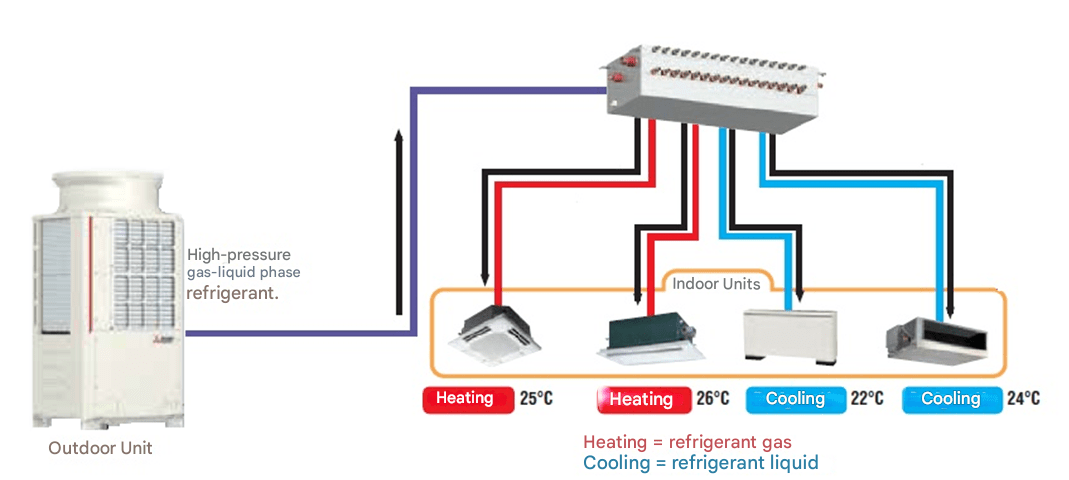
Introduction
1
The Earth receives daily energy in the form of radiation from the Sun.
Like any hot body, it emits radiation into space.
A part is trapped by gases that are part of the atmosphere, establishing a balance between the energy it receives and the energy it dissipates. It is what is known as the greenhouse effect.
Thanks to this the land is habitable.
The global average temperature of the Earth in the 20th century was 13.9ºC.
https://www.ncei.noaa.gov/access/monitoring/monthly-report/global/202213/supplemental/page-6
If these gases did not exist in the atmosphere, the average temperature would be around (-18ºC.)
In industrial processes, greenhouse gases are released, which are added to those existing in the atmosphere.
These gases catch part of the heat emitted by the Earth, causing an increase in the global warming of the planet.
Fluorinated gases used as refrigerants have a high heating potential.
To quantify it, it is taken as a reference that of the co2.
The European Green Deal in the 11-12-19 commission sets to make Europe the first climate-neutral and non-polluted continent by 2050.
To do this, on February 7, 2024, Regulation (EU) 2024/573 of the European Parliament and of the Council on fluorinated greenhouse gases is published.
All this invites an analysis, on the systems currently installed, in execution and planned in the short and medium term.
We Resolve as an integral maintenance company of unique buildings, with extensive experience in the hotel field, very sensitive to the environmental impact, has initiated the study of the problems that are currently present and in the coming years, in order to provide technical advice to their Clients, both in Spain and in America, although this demand at the moment only affects Europe.
Publication, entry into force and application
1
The EU Regulation 2024/573 was published in:
“Doue” no. 573, from February 20, 2024.
hereinafter it will be called F-Gas Regulation 2024
DEPARTMENT:
European Union
Reference:
DOUE-L-2024-80236
Entry into force:
Article 38
Entry into force and application
This Regulation shall enter into force twenty days after its publication in the Official Journal of the European Union..
Article 12 and article 17, paragraph 5, will be applicable from January 1, 2025.
Article 20, paragraphs 2 and 3, and article 23(5) shall apply from 3 March 2025 with regard to the free practice referred to in Article 201 of Regulation (EU) No. 952/2013 and all import and export regimes.
This Regulation shall be binding on all its elements and directly applicable in each Member State.
Global warming potential (PCG)
1
The new F-Gas 2024 establishes the terminology in its article 3 paragraph 1
Global warming potential (PCG)
“Global warming potential” or “PCG”: the climate potential of a greenhouse gas with respect to that of carbon dioxide (CO2), calculated in terms of global warming potential over 100 years, unless otherwise specified, of a kilogram of greenhouse gas with respect to that of one kilogram of CO2, according to the provisions of Annexes I, II, III and VI, or, with regard to mixtures, calculated according to the provisions of Annex VI;
In the previous one appeared the acronym PCA (Potential atmospheric heating), which has been replaced by the current PCG.
Keep in mind that the co2 which is used as a reference, is a greenhouse gas, to which a PCG equal to 1 has been assigned.
Very used refrigerants such as the R-410A, have a PCG of 2,088.
which indicates that 1 kg of R-410a that goes into the atmosphere, has the same global warming power as 2,088 kg of CO2.
refrigeration machines
1
The refrigeration machines are designed and built based on the refrigerant to be used.
If a machine is manufactured for a certain refrigerant, it will hardly admit another to replace it.
When tried, problems of different kinds have arisen.
For example, when the R-22 is replaced by the R-407C.
Currently, there are many refrigerants that do not admit any substitution, so the machines would no longer have utility.
REGULATION ON REFRIGERANTS
1
F-Gas Regulation 2024
Regulation (EU) 2024/573 of the European Parliament and of the Council on fluorinated greenhouse gases
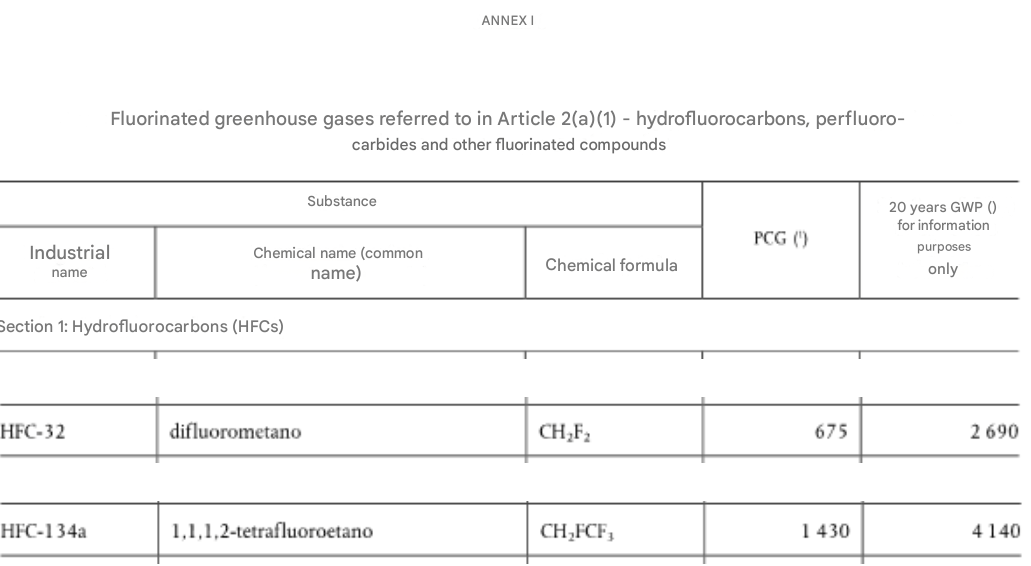
Its application to the greenhouse gases listed in Annexes I is specified in Article 2 a.
The pure HFCs appear in which they are indicated:
- Industrial designation
- Chemical name (common name)
- Chemical Formula
- PCG (Global Warming Potential)
A large part of the refrigerants used are mixtures.
It is indicated in this Annex:
Mixtures containing substances listed in this Annex are considered Fluorinated greenhouse gases to which this Regulation applies.
Safety Regulations for Refrigeration Installations (RSIF)
Royal Decree 552/2019, of September 27, which approves the Safety Regulations for refrigeration installations and their complementary technical instructions.
The refrigerants currently accepted by current regulations are specified in Appendix 1 Table A.
When a new refrigerant arises after the issuance of the regulations, it must be published in the BOE so that it can be marketed.
Each refrigerant contains the following information:






In that table there are refrigerants in its terminal cycle, along with the newly implemented ones.
The acronym PCA (Atmospheric Warming Potential) corresponds to the old Regulation of the European Union and the RSIF. It is now renamed PCG (Global Warming Potential).
The data contained in the new Regulation F-Gas 2024 coincide with those of the Safety Regulations for Refrigeration Installations (RSIF).
Informative note
Recently, an informative note has been issued

in which it is alerted to other refrigerants that have appeared on the market extremely flammable that are being marketed as equivalent to R-32, R-410 and others.
In that note he warns:
It should be noted that in compliance with article 18 of the RSIF, the owner must ensure that the installation is maintained by a company enabled, and that the refrigerants that are handled are those corresponding to their installation, and not others, having to keep all this data up to date in the installation’s log book. Therefore, the responsibility for the use of unauthorized refrigerants rests with both the handling agent and the owner of the facility..
Comments
The machines can equip pure coolants or mixtures of refrigerants.
In the F-Gas 2024 Regulation The cigars are indicated, as is the case for example of HFC-32 and HFC-134A, corresponding to R-32 and R-134a, of the Safety Regulations for Refrigeration Installations (RSIF)
It is in the RSIF where all the refrigerants that can be used in Spain, either in its pure state or forming mixtures, are specified.
To determine the PCG of a refrigerant mixture, the values established in Regulation F-Gas 2024 are taken, multiplying it by the corresponding percentage of the mixture.
Example
The R-410A is 50% mix of:
50% HFC-125 with a PCG of: 3,500
50% HFC-32 with a PCG of: 675
The R-410A PCG will be:
As can be seen in the RSIF table, the value indicated for the R-410A is 2.088.
Refrigerant mixes and mixing problems
In the RSIF table, there are many mixtures of refrigerants.
Two types can be given:
azeotropic mixtures
It is called azeotropic mixture of refrigerants when they have the same properties.
The evaporations and condensations of each of them bear similarity and if there is a leak in the circuit, the same proportion of one as the other will escape.
Example of azeotropic mixture is the R-410A.
If there is a leak, just fill the gas that has escaped through the crack.
Zeotropic or (non-Azeotropic) mixtures
It is called zeotropic or non-azeotropic mixture of refrigerants when they have different properties.
The evaporations and condensations of each of them are not similar and if there is a leak in the circuit, different proportions of gases will escape.
An example of a zeotropic or non-azeotropic mixture is R-407C, which is a mixture of three refrigerants with different properties and which initially replaced R-22.
What problem does zeotropic or (not azeotropic) mixtures have?
Gas cannot be added in case of leakage, because having exited through the crack plus gas of one of the components with respect to others, the resulting mixture would be different.
In that case, it is necessary to remove all the gas from the circuit and replace it with new gas.
Problems that may appear in the future
As the machines are designed for a specific refrigerant, if a substitute obtained through a zeotropic mixture appears on the market, maintenance becomes more expensive by having to empty and fill the circuit after a leak.
Refrigerant stop dates
1
The dates set in the F-Gas 2024 regulations are very restrictive for manufacturers.
In the Annex IV The prohibition dates are set for both refrigerants used in industrial cold and in air conditioning.
It also alludes to exceptions to existing installations if they are necessary to meet safety requirements in the operating area.
Some cases are analyzed.
3) Refrigerators and freezers for commercial use (autonomous appliances):
c) containing other fluorinated greenhouse gases with a PCG equal to or greater than 150.
January 1, 2025
Products and devices with a ban date after 2024 are indicated
 5) Refrigeration appliances, except coolers and hardened equipment in points 4 and 6, which contain or whose operation depends on:
Products and devices with a ban date after 2024 are indicated
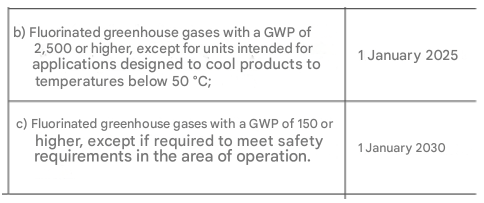
7) Coolers that contain or whose operation depends on:
Products and devices with a ban date after 2024 are indicated
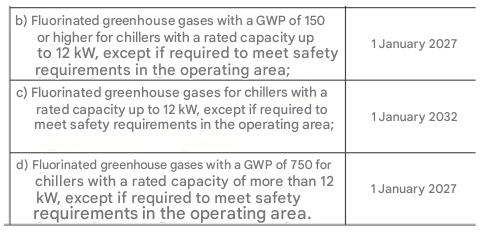
8) Self-contained air conditioners and heat pumps, except coolers:
Products and devices with a ban date after 2024 are indicated
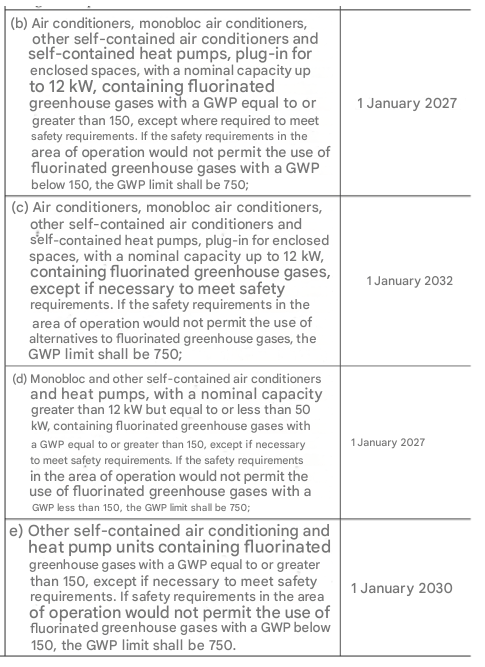
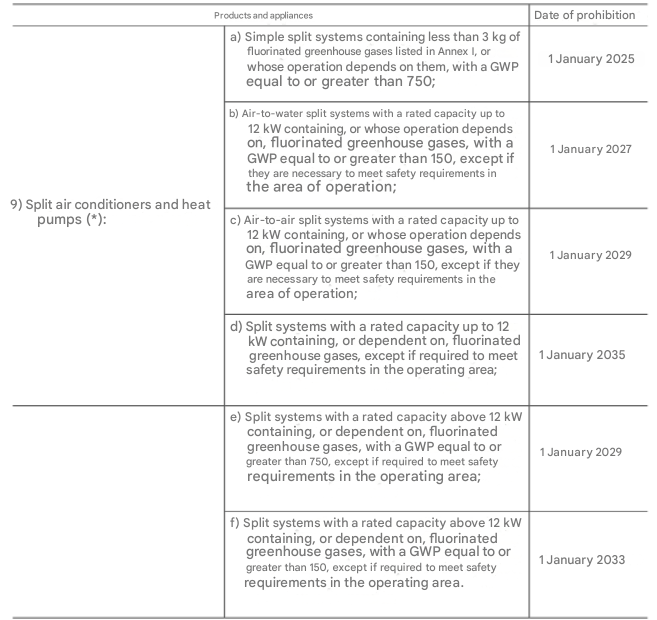
Summary Prohibition dates for major refrigerants
1
To verify if a refrigerant is still valid, you must take into account:
F-Gas Regulation 2024
- Indicates the type of installation and based on it sets the date
Safety Regulations Refrigeration Facilities (RSIF)
- Indicates the PCG of the refrigerant
Kimikal, a refrigerant distribution company, has prepared some tables in which the main refrigerants that are currently marketed are collected, in accordance with the regulations F-Gas 2024, Taking into account the PCG of each of them, which appears in the Rsif.
In the new facilities:
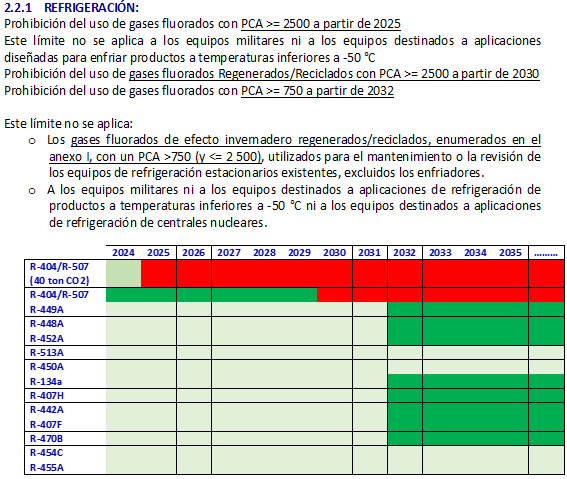
Fixed cooling
1
Annex IV paragraph 5 b) c)
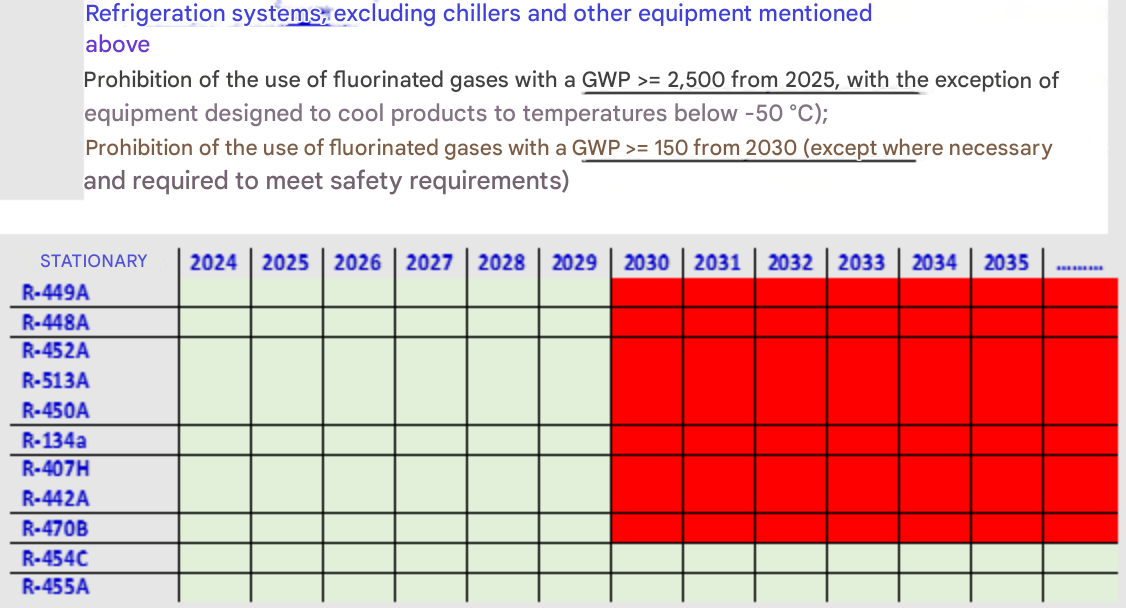
PCG fluorinated gases equal to or greater than 150 are represented.
Example:
134a: Banned for new installations in 2030
455a It is still valid from 2030 because it is its PCG below 150
ANNEX IV SECTION 6
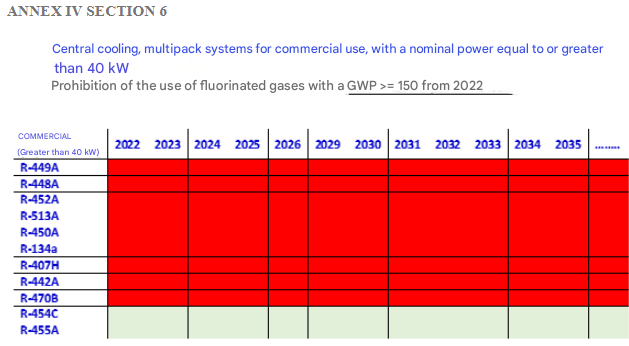
PCG fluorinated gases equal to or greater than 150 are represented.
Banned since January 1, 2022
Example:
134a: In this type of installation it cannot be installed
455a It is still valid from 2030 because it is its PCG below 150
Fixed coolers
1
ANNEX IV SECTION 7
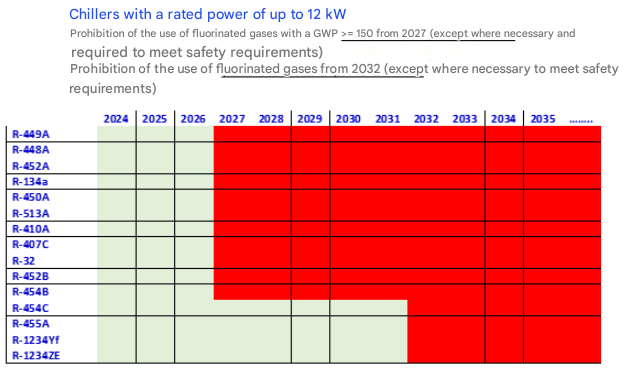
It is observed that in the table there is no refrigerant that exceeds the date 2032
R-410A Not valid from 2027
R-32 Not valid from 2027
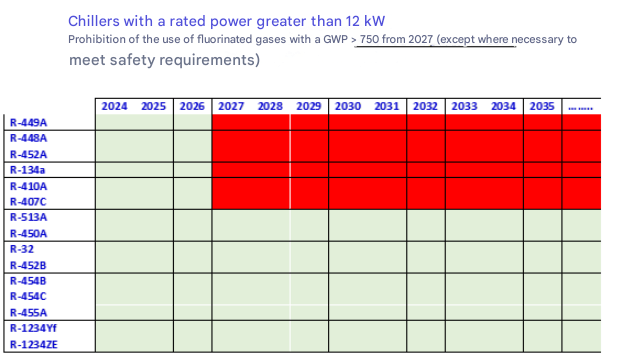
PCG fluorinated gases equal to or greater than 750 are represented.
Banned since January 1, 2027
Example:
134a: In this type of installation it cannot be installed from 2027
455a It is still valid from 2030 because it is its PCG lower than 750
R-32 It is still valid from 2030 because it is its PCG lower than 750
It is observed that refrigerants admissible for chillers with nominal power greater than 12 kW., such as large plants, admit for example R-32.
However, they cannot be installed in units less than 12 kW., from 2027
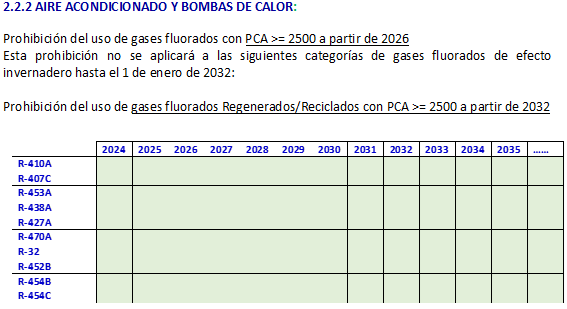
Fixed air conditioning appliances and fixed heat pumps
1
Annex IV paragraph 9 a)
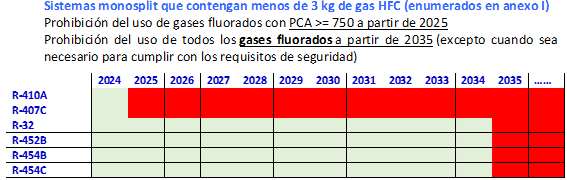
The R-410A is no longer valid in 2025
The R-32 is no longer valid in 2035
Annex IV paragraph 9 b) d)
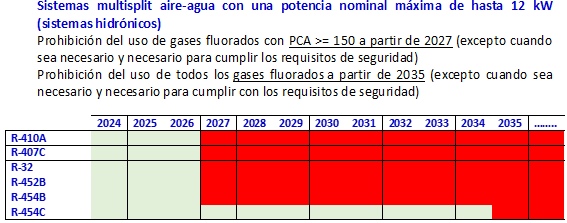
The R-410A is no longer valid in 2027
The R-32 is no longer valid in 2027
Annex IV paragraph 9 c) d)
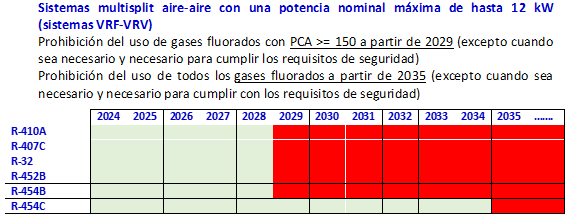
In this case it is observed that the R-410A and the R-32 cannot be installed in 2029
Annex IV section e) f)
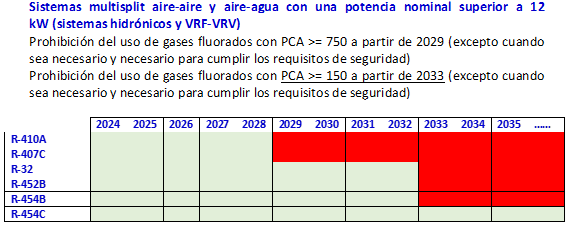
In this case it is observed that the R-410A cannot be installed in 2029
For the R-32 the deadline is 2032 and cannot be installed in 2033
Maintenance
1
Article 13 “Control of use”
In relation to maintenance in refrigeration and air conditioning, the F-Gas 2024 regulation is less strict, in order to keep existing facilities in service, although establishing conditions.
Allusion is made to maintenance in:
point 3

Point 4 (Section B)

Point 5 (Sections A and B)


In practice, there would be some restriction in refrigeration and practically none with the gases that are currently used in air conditioning and heat pumps, with the indicated restrictions.

Fluorinated gas fees and taxes
1
For the progressive elimination of fluorinated greenhouse gases, manufacturing quotas are reduced and taxes are increased.
This reduction will predictably result in an increase in prices in the coming years, due to the imposed limits.
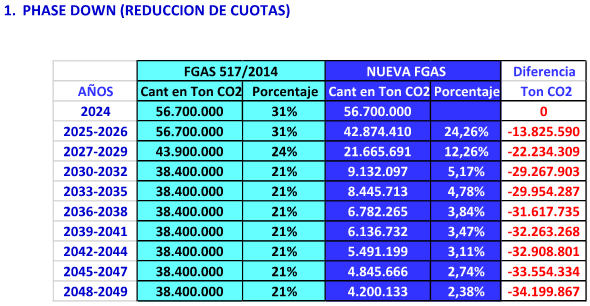
Kimikal (reduction of quotas)
To the prices of gases, the existing tax in Spain based on the PCA was added so far. (currently PCG)
Added to this tax is the one set by the current F-Gas 2024 Regulation.
Royal Decree 712/2022, of August 30, which approves the Regulation of the Tax on Fluorinated Greenhouse Gases.
Law 14/2022, of July 8, of modification of Law 19/2013, of December 9, of transparency, access to public information and good governance, in order to regulate the statistics of microenterprises, small and medium-sized companies (SMEs) in public procurement.
This law establishes in its article 12 a tax rate for gases based on their atmospheric heating potential. With the terminology of the new F-Gas 2024 (PCG) global warming potential
twelve. tax rate.
The tax rate will be constituted by the result of applying the coefficient 0.015 to the atmospheric heating potential that corresponds to each gas Purpose of the tax at the time of the taxable event in accordance with the regulations currently in force at that time, with the maximum limit of 100 euros per kilogram.
In the case of products, equipment or devices that contain gases subject to the tax and its atmospheric heating potential is unknown, it will be presumed, unless proven otherwise, that the tax rate to be applied is 100 euros per kilogram.
F-Gas Regulation 2024
ARTICLE 17
Determination of the reference values and quota allocation for the introduction of hydrofluorocarbons in the market
section 5
The allocation of quotation will be subject to the payment of the amount owed, which is equivalent to three euros for each ton of CO2 equivalent to being assigned.
Example
Taxes R-410 a.
The PCG is 2,087.5
TAX. current: &n . bsp; &nbs . p; 2087.5* 0.015 = €31.31.
When the new tax indicated in Article 17 is implemented, it represents an increase of:
New F-Gas Tax 2024 2.087 * 3 = €6.26.
Conclusions
1
The European Parliament has set out to fight global warming
The fluorinated gases that are currently used have an excessively high global warming potential (PCG) that contributes significantly to the increase in temperature on the planet.
Deadlines are established in which its use is not possible, depending on the type of installation.
The machines are manufactured to work with a specific refrigerant, so if a substitute that complies with F-Gas 2024 does not appear, the machine cannot be used.
Gas manufacturing and marketing quotas are reduced.
Additional taxes are established for those already established.
Supplies are maintained for existing installations, although the reduction of quotas may raise the price in the coming years.
Potentially hazardous gases are marketed that represent significant risks and are strictly prohibited. (d)Responsibility for the use of unauthorized refrigerants rests with both the handling agent and the owner of the facility)
A new F-Gas 2024 tax is increased to the existing one in Spain.
The complexity of the correct application of the F-Gas 2024 Regulation is observed, given the number of types of installations in which the same refrigerant can be used, although with different expiration dates.
We Resolve will advise its clients in the current situation, as well as in any action that is required in the short and medium term, within the current regulations, in order to make investments profitable and reduce the environmental impact.
Literature
1
Diagrams provided by Kimikal
Regulations European Parliament (F-GAS 2024)
Regulation (EU) 2024/573 of the European Parliament and of the Council on fluorinated greenhouse gases
https://www.boe.es/buscar/doc.php?id=doue-l-2024-80236
Safety Regulations Refrigeration Installations
Royal Decree 552/2019, of September 27, which approves the Safety Regulations for refrigeration installations and their complementary technical instructions
https://www.boe.es/buscar/doc.php?id=boe-a-2019-15228
Information on gas installation
Royal Decree 712/2022, of August 30, by which the
Regulation of the tax on fluorinated greenhouse gases.
https://www.boe.es/buscar/doc.php?id=boe-a-2022-14274
Law 14/2022, of July 8, of modification of Law 19/2013, of December 9, of transparency, access to public information and good governance, in order to regulate the statistics of microenterprises, small and medium-sized companies (SMEs) in public procurement
https://www.boe.es/diario_boe/txt.php?id=boe-a-2022-11392
2/05/2024
José Arroyo Martín
Ingeniero Tecnico Industrial en Electricidad y Mecánica