

Introduction
1
The commonly used refrigeration system is compression cooling.
It is a thermodynamic process that develops in a closed circuit by passing a refrigerant through areas of low pressure and high pressure, so that it absorbs and dissipates heat.
The main elements are:
- Compressor
- Condenser
- expansion valve
- Evaporator
Two zones are distinguished.
High pressure (compressor-capacitor)
Low pressure (expansion valve – evaporator)
The cycle is the same for a window apparatus, a Variable Refrigerant Flow system, or a large chiller.
Apart from the energy needed to move the compressor (normally electric), an external fluid is required to condense and another external fluid to evaporate.
Air or water is usually used and hence the terminology of the type of installation.
First, the fluid that condenses is indicated and secondly, the fluid that evaporates.
Air – Air: condenses using air and evaporates using air
Air – water condensate using air and evaporate using water
Water – Air condensed using water and evaporates using air
water – water condensate using water and evaporate using water
This article analyzes the two most used systems, which correspond to those of condensation by air, due to the potential risks that the legionella bacteria can present in a condensed water system.
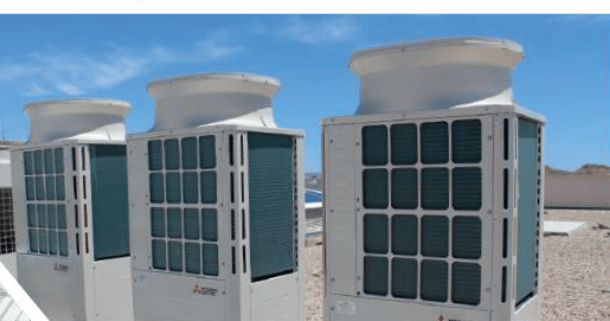
Air-to-air for a VRF system
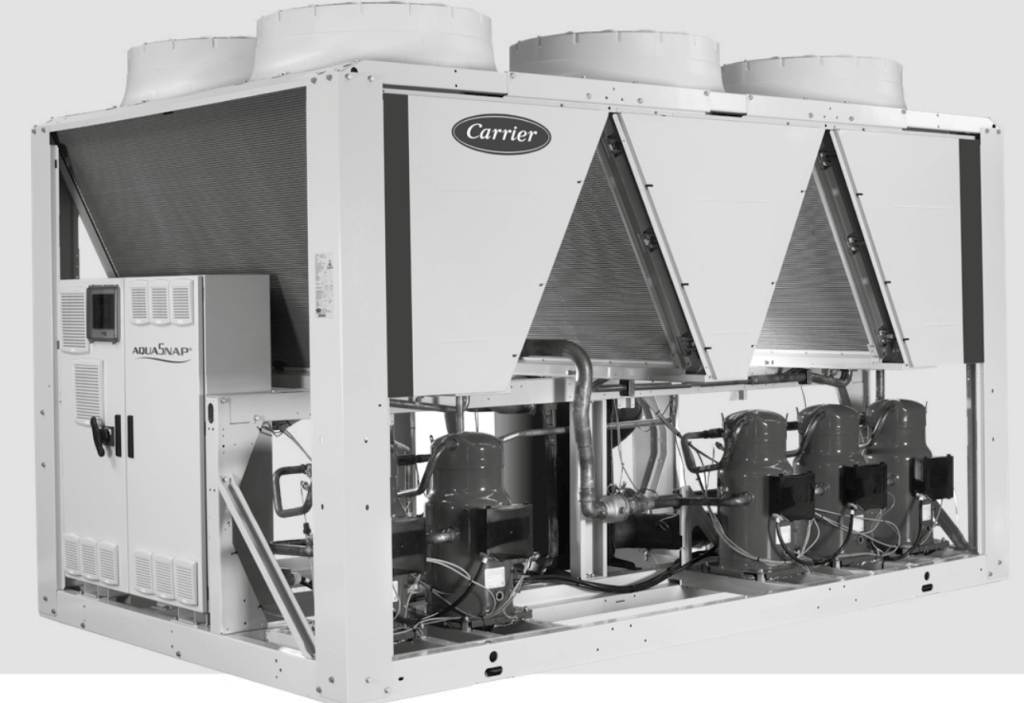
air-water for a centralized system.
VRF (Variable Refrigerant Flow) (air–air)
- Air is used to condense the coolant (outside air)
- The air is used to evaporate the refrigerant (air to cool enclosures)
Centralized system (air-water)
- Air is used to condense the coolant (outside air)
- Water is used to evaporate the refrigerant (cold water for distribution)
- From the evaporator, cold water is sent to fancoils of rooms and air conditioners, by means of pumps, to cool the enclosures
There are several options in each of these systems:
- Only refrigeration
- Heat pump (cooling or heating)
- Heat pump that provides simultaneously (cooling and heating)
In centralized systems (air-water), there is the possibility of installing an exchanger in the condensation circuit, which takes advantage of part of the heat generated in the compression process.
refrigeration machines
1
The machines used for the two systems analyzed
VRF
- Heat pumps are usually installed for cooling or heating.
- A heat pump system for simultaneous cooling and heating is an extra cost that would only make sense in very specific installations.
Centralized air-water systems
- Only chiller, when the heating is entrusted to boilers.
- Cooler with the optional recovery to take advantage of some of the condensing heat.
- Heat pump (cooling or heating).
- Heat pump with the optional recovery to take advantage of some of the condensing heat when it works as a chiller.
- Heat pump that provides both cooling and heating. It is known as a heat pump to 4 tubes.
What is a heat pump?
Heat pump is a refrigerating machine that extracts energy from the colder outdoor air.
A body that has a temperature greater than 0º Kelvin (absolute zero) has internal energy.
Taking into account that 0º Celsius or Celsius, which is the one we commonly use in Europe, is equivalent to 273, 15º Kelvin, it is possible to extract energy from the ambient air and this energy is used to heat.
It is what is called aerothermal.
Its operation is the same as described. The only difference is that it uses the heat of condensation for heating and dissipates the coldest air that occurs in the evaporation process in the atmosphere.
used nomenclatures
1
Regarding refrigerants, the existing regulations are:
F-Gas 2024
- The EU Regulations EU 2024/573 published on February 20, 2024.
Rsif
- Royal Decree 552/2019, of September 27, approving the Safety regulations for refrigeration installations and its complementary technical instructions.
VRF and centralized systems
1
Two nomenclatures are used to designate VRF systems.
VRV: Volumen refrigerante variable
VRF: Variable Refrigerant Flow
Those manufactured with the latest technology will be analyzed. Compressors driven by inverter motors.
- Clarify that inverter engines use the currently more sophisticated technology in terms of speed variation and offer maximum performance in terms of energy consumption.
A VRF system can be compared to a refrigerating machine in which the terminal units (summer evaporators or condensers in winter), are displaced from the central core of the machine and attached to it by fluorinated refrigerant lines.
With respect to centralized systems, air-water will be analyzed from a pure chiller, to the most sophisticated four-pipe heat pump system.
In centralized systems there is a refrigerating machine that cools water, if it is only a chiller and cools or heats water if it is a heat pump. (The most sophisticated option cools and heats).
Hot or cold water is brought to the terminal units (fancoils), by the action of pump groups.
These are two perfectly valid systems and depending on the type of installation, they will be more or less suitable.
The caveat is made that in the comparative rooms or small hotel rooms are taken as a reference.
In noble areas where the rooms, restaurants, dance rooms, meeting room, etc. are located, the centralized system is far superior in comfort to which a VRF system can provide.
COMPARISON OF THE SYSTEMS
1
The comparison between the two systems is analyzed
VRF
- It is an exclusive system of each manufacturer.
- It is an exclusive system for each refrigerant.
- If the refrigerant is changed, neither the machines nor the installation are valid.
- It is an exclusive control system.
- There is not the slightest exchange between elements and equipment. From the first day to the end of the installation life, the manufacturer’s dependence on replacement parts, major breakdowns and control is total.
- The number of units is very high because the refrigerant charge is limited and regulated by current regulations (RSIF).
- The R-410A refrigerant, which is usually used, has a very high GPG (Global Warming Power) and its production will be restricted in the coming years.
- The system has no flexibility.
- It is not expandable
- Nor does it allow subdividing enclosures, if this reduces the minimum volume required to the smallest room depending on the refrigerant load of the circuit.
- A fault affects a set of enclosures, generally few because the limitation of the charge of the refrigerant is very restrictive and is imposed by the RSIF.
- The space occupied by the VRF units is wide and dispersed due to the number of machines required.
- It has a superior technology, adapts better to temperature variations in intermediate times, has a greater ease for assembly, the number of elements is lower, a sophisticated control and guarantees correct operation.
centralized system
- It is a fully open system.
- Chillers or heat pumps from any manufacturer can be installed.
- The mission of the production elements are completely independent of the distribution and terminal units.
- Pipe networks are maintained throughout the life of the installation.
- With inert materials that are used lately, corrosion risks are removed.
- The same happens with the rest of the elements, valves and accessories.
- Terminal units (fancoils or air conditioners) can be installed from any manufacturer due to the fact that they are elements with a coil and a fan.
- Refrigerant is water.
- A breakdown in a fancoil just leaves out that room.
- Control is never exclusive, control elements can be installed from a large number of manufacturers with open communication systems.
- It is perfectly expandable and does not have any type of restriction due to refrigerant leakage.
- Any piece is standard and exists on the market.
- The engine room occupies less space and is centralized.
- The design depends on the qualification of the engineering, the number of elements is extensive, it has less flexibility to cover the seasons with variations in temperatures in spring and autumn, unless a more sophisticated four-pipe system is installed, the control is external and requires a detailed definition of the modes operating.
installation design
1
Once the load calculation has been done, the design of the installation is very different between the VRF and centralized systems.
VRF
It is highly studied, given that the assembly schemes, the calculation of the pipes, the necessary elements and everything related to the design is made with the manufacturer’s specific software.
It is the manufacturer that facilitates all the plans and schemes, without the need for external engineering to intervene.
centralized system
It requires a very detailed design and studied by engineering.
From the connection to the machine to the terminal units
- Bombs
- Pipelines
- valve
- terminal units
- Expansion
- Hydraulic controls
- Management and control system
- etc.
The design of the installation A VRF system is guaranteed by the manufacturer and a centralized system is subject to the engineering qualification that makes it.
Installation of the installation
1
The differences are as follows:
VRF
- simplifies to the maximum
- Highly detailed and defined plans and schemes provided by the manufacturer.
- relatively small tours
- Few elements designed for assembly.
- smaller diameter pipes.
- Requires highly qualified staff
- Assembly is fast
centralized system
- Assembly is more complex
- The level of definition of the plans will depend on the engineering.
- Greater routes with different types of pipes.
- larger diameter pipes.
- Greater implementation of elements and accessories.
- It takes up more space
- Assembly requires a longer time.
Change from cooling to heating
1
There are times during the year when energy demands are variable.
It can be in spring and autumn.
There will be days or times when the enclosure demands cooling or heating.
VRF
- When the installation is very subdivided, the volume of refrigerant to be heated or cooled is relatively small, so the winter-summer or summer-winter change occurs in a few minutes.
- It is a very flexible system that easily adapts to weather variations.
- It affects the set of rooms connected to the circuit.
- There is also the possibility of serving some rooms in refrigeration and others in heating with heat pumps prepared for this task, although with a higher cost and given the flexibility of the system, it is not usually necessary.
centralized system
- The centralized system has great inertia to make a winter-summer change.
- The usual thing is to arrive a date to proceed with these changes.
- There is a large mass of water to heat or cool and that is not immediate, nor is it possible.
- To ensure flexibility it would be necessary to go to installations to four tubes with a higher cost.
Control
1
Regarding the control system, if it is correctly designed and executed, it is the same in one system and in another, although in the VRF system the possibility of error does not exist and in the centralized it will depend on the design of the engineering and the integration carried out by the control company
VRF
- It is an exclusive system of the manufacturer in which all the elements of the installation are integrated.
- The communication between the elements is total and the maximum optimization.
- There is no possibility of error in the functions they have to develop.
- The maintainer or user only has to adjust the setpoint parameters and the system takes care of everything.
centralized system
- It is more complex and requires a comprehensive design that will depend on engineering.
- It is observed that on many occasions control companies are entrusted, to which a specific mode of operation is not provided, which penalizes the operation, the life of machines, elements and equipment, as well as energy consumption.
- Made these observations, a perfectly designed and realized control system should work the same as the VRF
energy consumption
1
Like everything, it depends what you compare.
Analyzing the operation in summer:
Energy consumption Refrigeration production
- It depends on the temperature difference between condensation and evaporation.
- For condensation the same element (outside air) is used
- For evaporation a temperature is set.
- As the temperature difference is reduced, performance increases.
VRF
- The evaporation temperature can be set.
- Normally, something lower is fixed, since the terminal units are optimized due to the existing limitation of refrigerant per circuit, in order to install the maximum possible units and since the Inverter system is capable of serving demand points.
centralized system
- The fancoils are selected to meet the refrigeration needs at higher temperatures.
- Therefore, the water in the chiller evaporates at a higher temperature.
- With a properly designed control, an evaporation ramp is also fixed based on the external conditions that further optimizes cold production.
In a correctly designed system, the energy consumption in refrigeration production is lower in the centralized system.
Energy consumption at partial load
A Partial Load Inverter engines have high performance.
VRF
- It adjusts at all times to the demand of the installation.
- When equipping inverter engines the performance is optimal.
centralized system
- If the centralized system uses compressors with inverter motors, the performance is higher, although they are of a high range that makes the installation more expensive.
- If compressors with conventional motors are used. The adjustment is not going to be so fine, so consumption is somewhat higher in general.
Energy consumption Latent heat of condensation in rooms
The air has in its composition water vapor, which condenses when a cold surface is found.
As the surface temperature decreases, the condensation increases, because the maximum amount of water vapor that air supports depends on the temperature.
Whenever a change of state occurs and the water of vapor to liquid passes, it is necessary to provide energy.
VRF
- Given the need to optimize in the design of this system, it normally evaporates at colder temperatures, making condensation greater.
- As more water vapor condenses, energy consumption increases.
centralized system
- In a centralized system, the temperature of the water to the terminal units is generally higher than that of the VRF systems.
- In addition, in a correctly designed system, the temperature that reaches the fancoils will depend on external conditions, so when sending water at a higher temperature, condensation decreases.
- The energy consumption due to condensation in the terminal units is lower than VRF.
Distribution to terminal units
The distribution of the refrigerant to terminal units is different in the two systems.
To get the refrigerant to the terminal units, an energy is required.
The power required for a pump is:
Power = Flow * Pressure
- Power is a cubic function
- Flow is a linear function
- Pressure is a quadratic function
VRF
- The refrigerant reaches the terminal units directly driven by the compressor.
- The refrigerant flow rate is less than in a centralized system
- The pressure is higher than that of a centralized system
centralized
- The refrigerant (in this case water) reaches the terminal units (fancoils) driven by pump groups.
- The flow is higher than VRF.
- The pressure is lower than VRF.
- In the new installations, the trend is variable flow so that the pump is adjusted to the demand of the installation.
The energy consumed in pumping could be somewhat lower in a VRF system, although it is estimated that it is not much lower due to the high pressures at which it works.
If a VRF system is compared with a conventional installation of constant flow and an insufficiently integrated control, the energy consumption of the VRF is much lower than that of the centralized system.
If compared to a centralized system even without having inverter technology with a perfectly integrated control, the energy consumption of the centralized system will depend on the indicated parameters.
There will be facilities and times when one is superior to the other.
Therefore, when comparing, energy consumption is not considered a differential factor in favor of either of the two systems.
number of machines
1
In this case there is a big difference between a VRF system and a centralized one.
VRF
- The number of machines to be installed is excessive
- Based on the type of refrigerant, there are limitations specified in the Regulation (RSIF) due to:
- Toxicity
- Inflammability
- Classification of the premises
- Site type
- which limits the gas load in the refrigeration circuit, forcing the installation of a large number of machines to serve with each of them few rooms.
- To serve a medium or large hotel, they require a very high number of outdoor units, occupying a large fully dispersed area, since there must be the minimum possible distance between the outdoor and indoor unit.
- Currently, as a refrigerant, the R-410A is used



Table Safety Regulations Refrigeration Installations (RSIF)
- The R-410A has a practical limit of 0.44 kg./m3., which limits the load that it is possible to install on a circuit that serves several rooms, taking into account the smallest room.
- In the RSIF comes the following example
If the smallest room is 16 m2, and 2.70 m. height, the maximum allowable load on the circuit would be:
Maximum load=0.44*16*2.7=19 kg
- What would happen at the load level of the refrigeration circuit if it were used, for example, R-32, which is being used in some chillers?
Maximum load R-32=0.061*16*2.7=2.6 kg
With that load per circuit, this refrigerant could not be installed.
And it is that the practical limit is reduced to 0.061 due to flammability.
centralized system
- There is only one place where all the machines are installed.
- The refrigerant that reaches the terminal units is water.
- The facility does not have the slightest risk.
- The terminal units (Fancoils) are not limited to any circuit, the necessary ones can be installed throughout the distribution.
refrigerants
1
The deadline for refrigerants is limited by the F-Gas 2024 regulation
VRF
- The refrigerant currently used is the R-410A.
- Its PCG (Global Warming Power) is 2,088.
- The amount of refrigerant is very high.
- The new F-Gas 2024 Regulation sets the limit on the installation of units that work with this gas on January 1, 2029
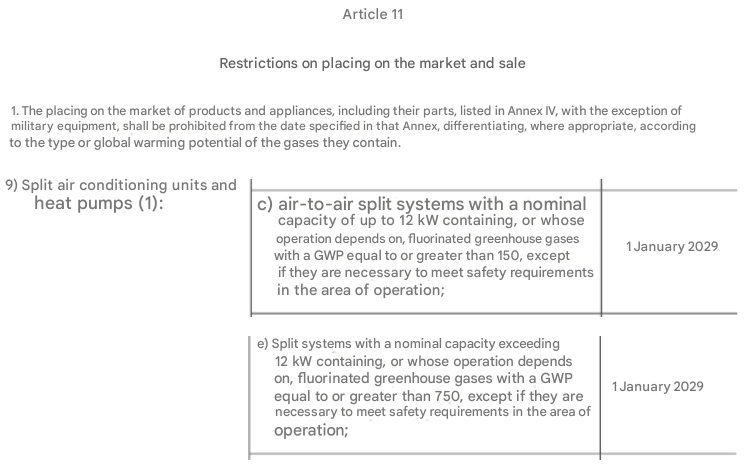
F-Gas Regulation 2024
Therefore, a VRF system with R-410A cannot be part of new installations as of January 1, 2029
centralized system
- Other types of refrigerant are used because an air-to-air cooler or heat pump is placed outside.
- The amount of refrigerant is very small, it is limited to that which is integrated into the machine.
- The refrigerants that are currently used in the cooling machines or heat pumps have a much lower PCG than the R-410A.
Condensation heat use
1
An air-to-air VRF system and an air-water centralized system can generally have equivalent energy consumption.
Both in one and the other, the heat of condensation in the summer season dissipates into the atmosphere.
If utility is found to be useful, an extra energy is obtained for other processes.
Domestic hot water is produced in all hotels.
In others there are other services that can demand heat in summer such as swimming pools and spa.
VRF
- Being an air-to-air system, it is not possible to take advantage of the heat of condensation.
centralized system
- It allows a use of part of the heat of condensation for the free production of domestic hot water or any other service.
- If the centralized system is of the heat pump type, during the winter it can be used for preheating of domestic hot water in a more ecological way and with better yields than boilers.
The use of condensation heat is a completely free energy that reduces energy cost and greatly improves environmental impact.
Installation life
1
The useful life of the installation will depend on the maintenance, the working conditions and the elements and materials installed.
However, there are conditions that limit the shelf life.
among them, spare parts and refrigerants.
VRF
- The machines that are currently installed will no longer be manufactured as a deadline in 2028.
- The manufacturer will be able to guarantee spare parts and supply supplies up to 10 years later.
- The refrigerant will gradually reduce so that its prices and taxes will presumably increase.
- The spare parts must necessarily have a higher cost because the manufacturer is obliged by law to supply it, forcing him to stop and manufactures on demand.
- In a VRF installation at the time that does not have spare parts, it not only stops working the element in question, but the entire installation.
- At the time it is necessary to replace the machines, nothing can be used, not even the pipe, because it is specifically built for the R-410A.
centralized system
- They equip refrigerants with a longer period of life and only affect the chiller or heat pump.
- The number of necessary spare parts are limited solely and exclusively to the machine and the expectations regarding their lifetime are higher.
- Of all the elements of the system, only and exclusively the machine can be affected by a longer-term change of refrigerant than that set for the R-410A.
- Any machine can be replaced by any other manufacturer.
- The rest of the installation does not affect the change of machines, it remains unchanged and the periods of life are considerably extended.
- Spare parts are always guaranteed because there are many manufacturers that build all the elements of the installation, pipes, fancoils, valves, expansion vessels, thermostats, etc. etc.
environmental impact
1
There is great awareness regarding the environmental impact, due to the emission of fluorinated greenhouse effect refrigerants.
In this case, the environmental impact can be analyzed from a double point of view.
refrigerant leaks
Life period of machines Elements and equipment.
In fact, the new legislation goes against the obsolescence programmed due to the impact of the manufacture of new elements.
VRF
- Regarding gas leak, the RSIF sets out in its Appendix 2:
Total Equivalent Impact on Atmospheric Warming (Tewi Total Equivalent Warming Impact)
- This parameter evaluates the global warming produced over the life of the cooling system’s operation.
- The three impacts that TEWI considers are:
- Lost due to leaks
- losses due to recovery
- impact due to the energy consumed.
- Of these, the first two greatly affect the emission of refrigerant into the atmosphere.
- On the impact of the energy consumed, normally electric and increasingly ecological, in a well-designed system it can be considered the same, so it would not have influence.
- Analyzing only the estimated leakage losses that are calculated according to the formula:
L = 0.4 * (M)2/3
in which:
L: Refrigerant leaks in Kgs./year
M: refrigerant load in kgs.
- Considering a facility in which there are only 100 kg of refrigerant, the estimated leaks per year are:
L = 0.4 * (100)2/3 = 8.62 kgs.
- Taking into account that 8.62 kg of R-410A causes annual global warming equivalent to:
PCG = 8.62 * 2088 = 17,999 kgs of CO2.
for every 100 kg. of refrigerant that is installed and only due to leaks, the estimate is of a contamination equivalent to 18 tons of CO2
- Regarding the life of the installation:
- The foreseeable life period for a VRF installation will be limited, due to the limitation on the use of the R-410A and the non-making of units for this refrigerant, so the manufacturer is not obliged to supply parts ten years after the machine. stop manufacturing.
Central installation
- With regard to gas leakage, there will only be the one that occurs in the machine, which is where there is only greenhouse gas.
- In the rest of the installation the refrigerant is water.
- The amount of gas equipped by the machine is negligible compared to the much lower VRF system and the refrigerant gas PCG.
- The F-Gas 2.024 regulation extends the life of the chillers and heat pumps depending on the refrigerant they equip.
- Therefore, the half-life of the chiller or heat pump will be higher than those of the VRF system.
- On the other hand, the durability of the installation as a whole is much higher due to the installation of the machine being installed, the rest of the components are maintained.
- As there is a greater use, the life of machinery is extended, elements and equipment that greatly improve the environmental impact
maintenance and breakdowns
1
With regard to maintenance, it is necessary to analyze the actions that it requires throughout the life of the installation and the preventive maintenance required by the RITE (Thermal Installation Regulations), and the corrective one (failures).
VRF
- Maintenance is multiplied by being a high number of units.
- Given the pressures at which it works, there is a potential risk of leaks throughout its useful life.
- Compressors, expansion valves and electronic components are multiplied.
- In each room the controller must be integrated with the outdoor unit because to maintain the temperature it is necessary to act on the expansion valve and the fan.
- Faults affect the set of rooms served by the machine.
- It requires a high degree of professional qualification because they are elements of the machines, control and refrigerants.
- Exclusive parts on all machines (one supplier)
- Exclusive control on all machines. (one supplier)
- Major fault repairs (manufacturer’s technical service)
- All nets are fluorinated refrigerants
centralized system
- Removing the maintenance of the chiller or heat pump that requires a high degree of professional qualification, the rest can be carried out by any qualified maintainer who is an expert in thermal installations.
- The pressure in the water distribution is low and the tubes built with inert materials, which minimizes the appearance of faults.
- In the terminal units there are no sophisticated electronic elements, only thermostats to control their operation.
- Any breakdown that occurs in a fancoil only affects that room, is isolated with the valves and the installation remains operational.
- The elements that are part of the installation are manufactured by many companies
- Control is within standards and is manufactured by many companies
- Refrigerant is water.
Costs due to maintenance and breakdowns are higher in the VRF system with respect to the centralized one.
Investment
1
Although the VRF system is made up of a large number of refrigerated machines with sophisticated electronic systems, lately the initial investment may be more profitable compared to a centralized system.
The cost of the electrical installation to serve such a high number of machines is higher.
electrical installation
VRF
- The installed power is increased by requiring multiple machines installation, which must be brought lines capable of serving their nominal power.
- The wiring is greatly increased by having to serve a far superior set of machines.
- Likewise, electrical panels given the need to protect a much higher number of machines.
centralized system
- Being all centralized there is only one engine room, a connection and a frame.
It is possible that by adding the cost of the increase in the electrical installation, the initial investment continues to be more favorable in a VRF system.
If the complementary investment is analyzed over the years, with the harsh conditions imposed by current legislation in relation to refrigerants, maintenance, breakdowns and spare parts, as well as the limitation of the useful life of the installation, a centralized installation is more profitable.
Conclusions
1
This article has tried to analyze in the most objective way possible the advantages and disadvantages of VRF and centralized air-water systems, for hotel rooms.
The advantages and disadvantages have been indicated in each of the points developed.
as a general summary.
- The design of a VRF installation is guaranteed by the manufacturer, while in a centralized system it depends on the engineering qualification.
- The assembly of a VRF installation is faster, few elements and all defined in its smallest details. In a centralized system there is a greater number of elements and the specifications depend on the qualification of an external engineering.
- Control and software is developed by the manufacturer and there is total communication between all the elements. In a centralized system it will depend on the qualification of an external engineering.
- The technology that is generally used by the VRF system is superior to centralized systems.
- In a VRF system all elements have a single supplier. the manufacturer.
- In a centralized system there are many manufacturers that build all the components.
- The VRF system has total flexibility in winter-summer changes that can be done in a few minutes in spring and autumn, while a centralized system usually does it once in spring and once in the fall. If greater flexibility is desired in a centralized system, the cost increases.
- In VRF systems, maintenance and breakdowns have a much higher cost and require a staff with a degree of qualification.
- In a centralized system, any enabled maintenance company is trained to serve the facility.
- In a VRF system, the installation is dispersed and the number of machines is very high.
- In a centralized system there is only one engine room.
- In a centralized system there is also the possibility of obtaining heat from condensation, which can be used, for example, for free heating of domestic hot water.
- The environmental impact of a VRF system is very high, greatly affecting global warming.
- The environmental impact of a centralized system only affects the refrigerant contained in the machines with a much lower PCG. Water that does not have the slightest environmental impact arrives at the terminal units.
- The life of the VRF installation is limited to the supply of parts and refrigerant. When it is missing, it has to be completely disassembled and nothing can be used.
- The useful life of the centralized installation is much higher, even changing some machine, everything is usable.
- The initial investment can be more economical, although throughout life a VRF system will have a much higher cost due to maintenance, breakdowns and useful life.
Literature
1
Regulations European Parliament (F-GAS 2024)
Regulation (EU) 2024/573 of the European Parliament and of the Council on fluorinated greenhouse gases
https://www.boe.es/buscar/doc.php?id=doue-l-2024-80236
Safety Regulations Refrigeration Installations
Royal Decree 552/2019, of September 27, which approves the Safety Regulations for refrigeration installations and their complementary technical instructions
16/04/2024
José Arroyo Martín
Ingeniero Tecnico Industrial en Electricidad y Mecánica