

fires in electrical installations
1
Fires caused by electricity in hotel facilities can have various origins.
Apart from the deficiencies of the cables, elements and equipment, which in themselves can cause fires, special attention must be paid among the defects of the installations.
Current greater than the permissible in the cables
- It occurs if the protections are not suitable.
- Proper protection disconnects the circuit.
- Increases the temperature of the driver.
- If it exceeds the limits that it is capable of withstanding the insulation, a deterioration of it occurs.
- The properties of dielectric strength and insulation resistance are reduced, so that current begins to circulate through them.
- In principle small
- As it loses properties higher and higher
- Attained the maximum bearable level by insulation, the fire starts.
electric arcs
- They occur whenever a circuit is connected or disconnected.
- There is a time when the contacts are very close
- air is ionized
- Jump the spark
- generates heat
- It depends on the voltage and the power of the connected receiver.
- The heat generated affects the insulation of the conductor and other insulating elements in the vicinity of the connection, reducing its dielectric strength and its insulation resistance.
- Once the maximum bearable level is reached, fire occurs.
Loose connections
- Connections should always be made using suitable elements that guarantee the continuity of the circuit. It is never admissible or regulatory, due to twisting of the cables.
- When they are crossed by the electric current they heat and dilate.
- When you let the electrical current pass, they cool down and contract.
- If there is not a sufficient degree of tightening, the continuity of the circuit is not fully guaranteed, leaving small air spaces.
- In these spaces, being very close, the air is ionized.
- an electric arc occurs.
- The heat generated is high.
- It affects cables and connection elements.
- Once the maximum level is reached, the fire appears.
short circuits
- Short circuits occur when the two-wire conductors are joined.
- At that moment the current does not pass through the receiver, but rather circulates between the two cables without any load interposed between them.
- The impedance of the receiver ceases to exist.
- The only existing impedance in the circuit is that of the conductors and the transformer, which is very small.
- The intensity is very high.
- The short circuit can occur between:
- Phases
- phase and neutral
- Phase and Earth
- If it is not disconnected quickly by the protection elements, the fire is guaranteed.
Causes of short circuits
- Accidental
- Two drivers join
- due to insulation deterioration
- Insulation loses properties with heat
- If they do not disconnect the overcurrent devices, the isolation tends to disappear.
- Decreases the resistance between conductors.
- The intensity is increased.
- The isolation ends up disappearing.
- Drivers join
- by the action of some rodent
- When biting two cables, contacting the conductors
electrical panels
- In electrical panels practically all the assumptions occur.
- There are a lot of cables.
- they are in contact
- heat is generated
- weakens isolation
- There are a lot of connections.
- They are very close
- If one is not tight enough heat is generated by electric arcs.
- Insulation deterioration in the connection elements and the cable terminals.
- Dirt
- Dust can enter the enclosure where it is located.
- If it is open as in some cases, dirt input is guaranteed.
- It can be affected by moisture.
- These humidity fix the dust to the elements, creating conductive traces between phases, phase and neutral and ground.
- Through these points, current circulates that, based on the degree of dirt, can be important, creating overloads that weaken the insulation and that can finally end up short-circuited.
- insects and rodents
- If you join two conductors a short circuit occurs.
- heat generated by the electrical switchgear
- The different elements that form an electrical panel, wiring, terminals, maneuvering elements, protection elements, etc. etc. They dissipate heat.
- If this heat is higher than the insulation allowance, its dielectric strength and its insulation resistance are weakened with the consequences indicated above.
- Cutting power of automatics
- If the automatic is not designed for the cutting power required for a short circuit, a fire is started to propagate to the rest of the frame.
- Other heat generating elements
- If, for example, a battery of capacitors is installed in the same electrical panel, an additional heat is generated that is added to the frame by increasing the temperature. If this increase has not been contemplated, the dielectric strength and insulation resistance decreases.
- Supports and fixings
- In frames with conductive bars, forces of attraction and repulsion are produced between the muddy. In the event of a short circuit and due to the circulating intensity, these forces are magnified, being able to destroy them if they do not have adequate supports.
Receiver connections
- In electrical installations there are many power outlets for the connection of receivers such as a hair dryer, an electric iron, a fridge, a radiator, a fan, etc. etc.
- Whenever a receiver is switched on or off, its switch must be turned off so that manual connection or disconnection can be made without any load on the circuit.
- then activate the switch.
- When disconnecting also previously disconnects with the switch,
- Indicate that the switch makes this connection or disconnect at high speed.
- These measures are not always taken. And there are many times that the equipment switch is activated.
- In that case
- Approaching the receiver’s plug to the socket base produces an electric arc.
- This arc generates heat, this heating affects the external material, creating an outer layer that can be seen with the naked eye due to it blackening as a result of the intense heat supported by connections and disconnections.
- It is also sometimes seen on the female connection of the wall socket.
- This layer created by the heat generated can give rise to additional small arcs that deteriorate it even more over time.
Dirt on the socket bases
Dust and moisture accumulate in the plug bases.
This combination can create a conductive path between the terminals that is intensified by placing the pin of a receiver.
When passing through the electrical current, the circuit created by dust and humidity can give rise to overcurrents that deteriorate the connection elements,
clearances between receiver plug and socket bases.
The receiver plug and the socket outlet cannot have any type of slack.
If the plug that enters the plug is smaller than the base of the plug, continuous electrical arcs originate in which a large amount of heat is generated and that deteriorates the insulating elements with the potential risk of fire.
Other fires with electrical origin
Every day to a greater extent, hotel customers use a series of electronic devices that require connections to the electrical network of the room.
It is for example the case of:
- mobiles
- tablets
- computers
- Electric scooters
These devices are a source of fire, caused mainly in batteries, especially that in many cases they do not use original connectors of the brands.
They are an important focus of fires, so in addition to the detectors that are installed in each room, it would be advisable to alert of the danger by recommending connections in areas far from fuel elements.
need for proper maintenance
Electrical installations require proper maintenance, based on periodic inspections, which must be carried out by companies with the degree of qualification required.
Technical concepts
Basics
1
For fire to occur, regardless of origin, there must be
- Gasoline
- oxidizing
- Oxygen from the air
- Hot
It is the so-called fire triangle. If one of those components fails, there is no fire, and if it exists, when one of them exists, it is extinguished:
The fire is an uncontrolled fire.
It can be started with an ignition.
It can be initiated by overheating of the fuel element.
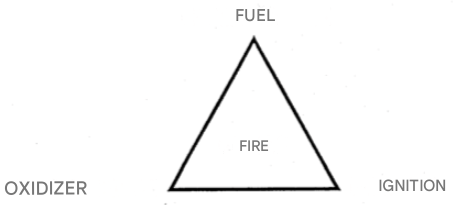
A cable is equipped with insulation, which in this case would be the fuel, located in an environment where there is oxygen. For it to burn, it requires heat.
In addition to the cable, there are other components in contact with electricity that can cause a fire, such as plug bases, connection terminals, lighting devices, electrical panels, etc. etc.
What causes a fire with an electrical origin
1
For fire to occur, regardless of origin, there must be
inadequate protections.
cable overheating.
overheating connections.
electric arcs
dirt on the elements.
short circuits.
electrical cables
1
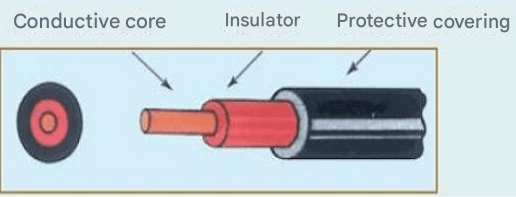
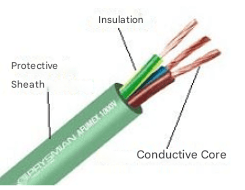
They are the elements that are used to transport electrical energy from its origin to the receivers.
They are formed by a metallic part through which electric current flows and an insulating part that protects the conductor.
Copper and aluminum are used as conductors.
For small sections always copper.
Regarding insulation, there are many types of cable.
Its typology will depend on the place of location, type of assembly and assigned function.
Lately, additional additional classifications with respect to fire have been required.
The typology of the cables is regulated in the regulations.
Cable heating
The heating of a cable occurs due to the passage of electric current.
It is proportional to the square of the intensity that circulates through it.
The intensity depends on:
applied tension
receiver power
With two simple formulas we know the behavior of the intensity in the electrical cable.
Ohm’s law states:
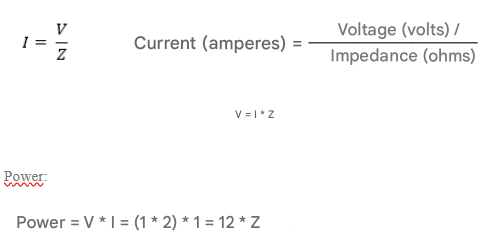 Impedance (Z) has two components
- Resistive (receptor electrical resistance)
- Reactive (receiver reactance)
The intensity that circulates through a cable depends on the applied voltage and the impedance of the receiver, apart from other distortions that appear when electronic circuits are fed.
- If it is an electric iron it will be a pure resistance (R)
- If it is a motor it will be an impedance (resistance + reactance) (Z)
- If it is electronic receivers, it must also be taken into account that harmonics are generated.
- Therefore, there will be cables that circulate at the same time intensities sum of (resistance + reactance + harmonics)
Electrical cables are subjected to electromagnetic effects caused by nearby cables, although for practical purposes they can be considered as a pure resistance (R).
Passing through the electric current a cable causes a loss of power that depends on the intensity and the resistance it offers.

All that power turns into heat, raising the temperature of the cable.
It is what is known as Joule effect.
The current that a cable supports is a function of:
Section
type of insulation
installation conditions.
are regulated in the electrotechnical regulations
As the cable has a smaller section, it offers greater resistance to the passage of electric current, increasing losses due to Joule effect and increasing its temperature.
To prevent the cables from heating, it is necessary to establish the appropriate magneto-thermal protections on the electrical panels.
A cable that under the conditions of the installation set by the Regulations can withstand a maximum current of 10 A., must have a protection of 10 A.
If, for example, a protection of 50 A. is installed, and the receivers demand 50 A., this cable will overheat, there is a potential risk that it could cause a fire.

Isolation
Its main mission is to prevent electrical conductors from getting in touch and can be handled without risks.
Remember that insulation is the combustible part.
The intensity that a cable supports will depend on the type of insulation that surrounds the conductor.
No insulation is perfect and can be traversed by electric current if the voltage between the conductors rises, or between the conductors and the ground, when ground and neutral are attached somewhere in the installation.
Isolation depends on several factors, among them the temperature that the cable can reach, being able to completely lose its insulating function if it increases to inadmissible values.
Insulating materials are called dielectrics.
dielectric strength
It is the maximum voltage that a conductor is capable of withstanding.
The material is insulating up to a certain voltage difference between the conductors or between the conductors and the ground.
The maximum tension that it is capable of withstanding without perforating its insulation is what is called dielectric strength.
Electrotechnical regulations specify a type of test for verification.
Dielectric strength varies with temperature and humidity.
If the cable becomes hot, the dielectric strength decreases and the insulation loses efficiency.
Insulation resistance
The insulators have to ensure a high insulation resistance set in the regulations
All cables are manufactured for a temperature range.
As this temperature increases, they lose properties.
1. Driver
Metal: Annealed copper.
Flexibility: Flexible, Class 5, according to 60228.
Maximum temperature in the conductor: 70 ºC in service
Permanent, 160º C shorted.
installation conditions
The installation conditions influence the maximum intensity that the cables can support.
An air cable located on a channel is not the same as a cable under tube in which there are also several grouped.
The heat that is generated by the passage of the current (Joule effect), in one case is easily dissipated and in the other case they are added with the other cables.
Maximum permissible currents in conductors
It is the regulations of each country that delimit the maximum admissible intensities based on section, type of insulation and assembly conditions.
operating temperature
The maximum operating temperatures of the cables depend on insulation.
Thermoplastic insulation 70ºC.
Crosslinked polyethylene insulation 90ºC.
maximum temperatures during a short circuit
Isolation. thermoplastic   . ; 160ºC.
Crosslinked polyethylene insulation 250ºC.
What happens if it is overcome?
The cables support a small overload for a short period of time.
If a short circuit occurs, the values of the insulations cannot exceed the set maximums.
Each cable depending on its insulation, supports an overcurrent for a while.
An example clarifies the concept:
a cable of 1.5 mm2., with thermoplastic insulation, it has features that appear in the manufacturer’s table.
It must be prepared to withstand a current of 173 A. for 1 second, 122 A., for 2 seconds or 86 A. for 4 seconds
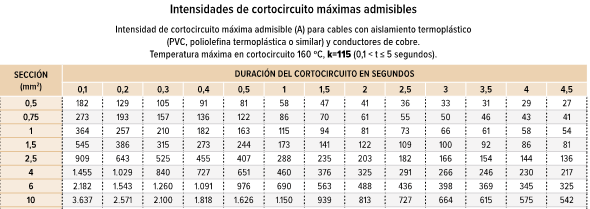
*Maximum permissible short-circuit currents 160ºC/k=115
*Square milimiter sections // Short-circuit duration on seconds
MIGUELEZ CABLE TABLE
If these values are exceeded, the limits established for isolation are exceeded.
From that moment and based on the temperature it reaches, there is a potential risk that it may burn.
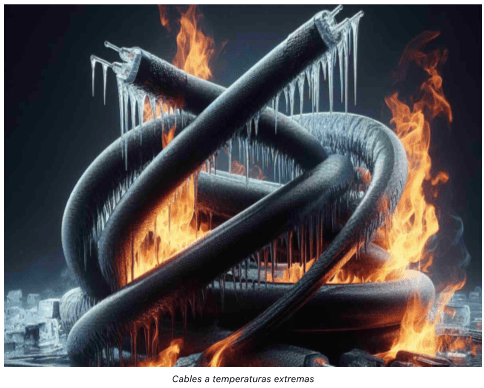
ZMS Cables
electric arc
1
It is a discharge between two electrodes in which there is a potential difference in a gaseous medium such as air.
When connecting or disconnecting a circuit, the air between the terminals goes from 0 to a high value.
Therefore, there is always an air layer that is ionized at the initial moments of connection and disconnection, when the contacts between the power supply and the bypass to the receiver are very close.
Therefore, the elements that make the connection and disconnection of circuits have very fast opening and closing mechanisms that minimize the effect.
The electric arc will depend on the voltage and the power of the installed receiver.
Sometimes overvoltages may appear on the premises that increase the effect.
The heat generated when an electric arc occurs is high.
There are many visible electric arc effects on some of the commonly used appliances.
An effect of the electric arcs is observed, for example, in some appliance pins due to the blackening of the tips, due to the heat generated at the moments of connection and disconnection. (These are manual maneuvers that maintain the effect of the arc for a longer time).
The high heat generated affects the insulation and the nearby insulating elements, causing the loss of its properties and being able to give rise to a fire.
The bibliography includes an ABB documentation detailing the electric arc that is generated in a magneto-thermal switch every time it connects or disconnects.
ELECTRICAL CONNECTIONS
1
Electrical connections must be made using connection elements with a sufficient degree of tightening that guarantee the continuity of the electrical circuit.
On loose connections, continuous electric arcs appear that present a potential fire risk.
The following must be taken into account:
- Whenever an electrical connection increases its temperature due to the passage of current, a expansion of the conductive element occurs.
- When power stops passing and the connection cools down, a contraction.
- These expansions and contractions in a loose connection cause that the continuity of the circuit cannot be guaranteed and small air spaces remain between very close conductors. In these spaces, electric arcs originate.
- The heat generated by the electric arc affects the conductor and the insulation.
- When the insulation deteriorates as a result of heat, it loses its insulating properties and there is a risk of fire.
- If that happens between two nearby conductors that feed a receiver, a short circuit occurs

DIMAE connection boxes
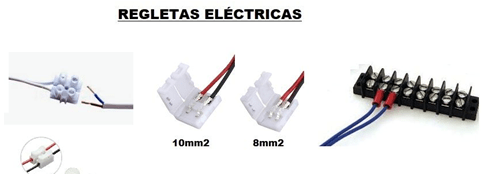
Technology Area Connections should always be tight
Short circuit
1
An electrical circuit is made up of:
- Connection to the mains
- cables
- Receiver
Suppose a single-phase electrical receiver that has an impedance of 50 ohms to which a voltage of 230 V is applied.
Suppose also that the impedance of the conductors between the transformer and the receiver is 0.01 ohm.
The intensity that circulates would be around this many amps:

If at the point where the receiver is located, the cables are joined, the 50 ohms, which is the impedance that the receiver opposes, disappears and only the impedance of the transformer-cable circuit remains.

*Short-circuit intensity
- If the cables are in good working order.
- If the magneto-thermal protections disconnect within the established time.
- If the cutting power of the magneto-thermal switch is correct
Nothing happens
if not
- There is a risk that a fire in the insulation will occur.
Short circuits can occur:
- between phases
- Between phase and neutral
- between phase and ground (when neutral and ground are joined at some point in the circuit)
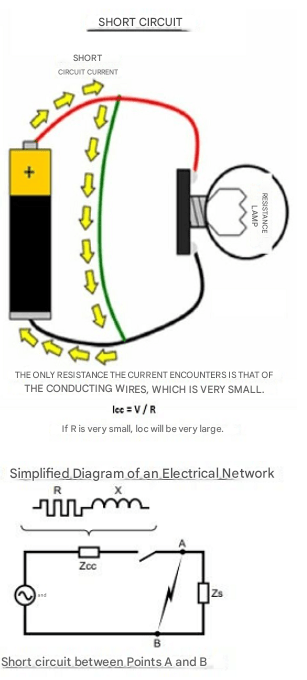
Technology area Short circuit in direct and alternating current
In the figures a short circuit is represented.
Up DC current (one battery)
Down AC current (a hotel circuit)
By joining the conductors, the electrical current stops passing through the receiver and follows the easier path, in which it does not find any obstacle.
In the simplified scheme of alternating current ZS is the impedance of the receiver and ZCC is the impedance of the transformer-cable circuit. If A and B are attached, the short-circuit current follows that path and stops passing through the receiver.
Automatic cutting powers
1
It is not always given the importance it requires of the cutting powers of the circuit breakers that protect electrical circuits.
Suppose a hotel has two identical rooms and equal electrical panels.
One is close to the transformer and the other is far away.
If a short circuit of the same characteristics occurs in one and the other, the short circuit current will be different.
This is because the resistance of the conductors between the room and the transformer is also different.
Applying Ohm’s law already stated:

The resistance of a cable is directly proportional to its length.
As a cable with the same section is longer, the resistance is greater.
The cables of the room closest to the transformer are shorter and with a larger section, having to serve upstream circuits and therefore have less resistance than those that reach the room furthest from the transformer.
Taking into account that the potential difference is the same, as the resistance of the cables decreases, the intensity increases.
The short-circuit current in the closest room will be much higher than the farthest room.
Therefore, although the protection is the same (for example 10 A.), the automatics must have a different cutting power to withstand the intensity that passes through it during the short circuit.
If not, there is a potential risk that the electrical panel may burn out.
Fires in electrical panels
1
In electrical panels there are all assumptions that can cause increased fires in some complementary ones.
Technology Area Connections Electrical panels
In many cases, due to poor design and to partially dampen the heat generated, they remain open, which represents a high potential risk.
- a large number of very close conductors, which generates heat
- Protection and maneuvering elements that also generate heat.
- A high number of connections very close to each other, which in case they do not have a sufficient degree of tightening can cause overheating and arcs that affects the entire frame.
- Possible accumulation of dust, moisture and dirt.
- Insect and rodent input that can join elements in tension.
- magnetothermals that do not have adequate cutting power.
- Mechanical faults in maneuvering elements.
- Overheating by other elements and equipment that provide additional heat (example condenser battery)
- All this causes an increase in temperature and a decrease in dielectric strength and insulation resistance.
These effects cause serious fire hazards in electrical panels that are not perfectly designed and executed.
Conclusions.
Global data on hotel and motel fires are revealing to what extent this is vital: the Fire Statistics Center shows that 10 000 fires were recorded in 2022, with 250 deaths and thousands of civilian wounded. The main causes of these fires were kitchen facilities, electrical equipment and smoking in establishments. Business losses in the sector reached 1,500 USD million in a year.
An important part of these fires are caused by electrical installations.
Electrical installations are essential for the development of hotel activity.
The design and assembly must be carried out in accordance with Lthe regulations existing in each country.
The technical concepts that cause fires have the same physical principles, and the adoption of protections to avoid them are similar.
The electrical installations present potentially dangerous risks, so the legislation requires a high degree of qualification for the technicians who work in this field, from design to execution, tests and maintenance.
literature
1
Fires caused by electric arcs Schneider Electric
Electric arcs on circuit breakers
Technology Area
https://www.areatechnology.com/electricidad/intensidad-cortocircuito.html
ZMS Cables
https://zmscables.es/temperatura-cables-electricos-isolados/#temperature-of-operation
12/09/2024
José Arroyo Martín
Ingeniero Tecnico Industrial en Electricidad y Mecánica