

Introduction.
1
In hotel facilities the importance of water is essential. It is totally necessary for the development of the activity.
Hotels and hotel complexes are very different from each other and there are from establishments with few rooms located in the center of the city, to large complexes located in different areas where the necessary infrastructures are not available.
There may be cases that for various reasons it is necessary to carry out a water collection to serve the hotel complex. In that case, the figure of the operator appears (defined in article 2 section P).
If the collection of water is for other uses such as irrigation, the requirements of the Royal Decree are not mandatory.
Royal Decree 3/2023 encompasses all the assumptions that can occur from water collection to its exit through the tap.
Italic letter will be used when texts that are part of the Regulation are reproduced.
The European Commission approved on December 16, 2020, a new standard, Directive (EU) 2020/2184 of the European Parliament and of the Council, of December 16, 2020, on the quality of water intended for human consumption.
To incorporate the requirements of the European Parliament directive, the Royal Decree 3/2023, of January 10, which establishes the technical-sanitary criteria of the quality of the water for consumption, its control and supply.
This Royal Decree entered into force on January 12, 2023.
In this article, the demands of this Royal Decree will be analyzed in the hotel facilities, once the water from the operator has been received.
The typology of hotels and hotel complexes are very varied.
For the purposes of this Royal Decree, the following are given:
Hotels with exclusive supply of drinking water from the distribution network:
- less than or equal to 500 accommodation places
- greater than 500 accommodation places
requirements of the Royal Decree.
1
The greatest demands are for the operators who are in charge of the collection of water, the ETAP (Printable Water Treatment Station), the tank or storage tanks and the networks to the buildings.
- The operator supplies drinking water to the building, suitable for consumption.
Below are the priority buildings. (In hotels greater 500 places accommodation).
They are followed by the rest of the hotels (equal or less than 500 accommodation places).
CHAPTER I – GENERAL PROVISIONS
1
(Articles 1 to 4).
Regarding the general provisions
Object (Article 1)
“Establish the technical and sanitary criteria of the consumption waters and their supply and distribution, from the masses of water to the user’s tap, as well as the control of their quality, guaranteeing and improving their access, availability, health and cleanliness, in order to protect the health of people of the adverse effects derived from any type of contamination”.
It therefore covers from capture to use.
Definitions (Article 2)
In 2.1 the terminology used in the Royal Decree is specified, from the purely technical to the administrative ones.
For example, water for consumption, collection, connections, tanks, competent administrations, typologies of buildings, treatment stations, etc. are defined.
In section z) the supply zones that affect the requirement of operators are established.
Scope of application (Article 3)
It is applicable to all hotel facilities.
This provision will apply to the waters of consumption defined in article 2.1.a) and 2.2.b) and to the collection waters defined in article 2.1.b).
Article 2.2.b) corresponds to a food company, which is not the case.
Article 2.1.b) corresponds to collection that is the responsibility of the operator.
ARTICLE 2.1.a)
Drinking water: water for human use, either in its original state or after treatment, used for drinking, cooking, preparing food, personal hygiene or other domestic purposes, both in public and private premises, regardless of its origin and if it is supplied from distribution networks, from tanks or in mobile tanks and Make it healthy and clean.
Responsibilities (Article 4)
In section 3 of this article, the responsibilities are established, clearly specifying who it corresponds to.
3. The owners of buildings or premises with public or commercial activity must:
a) Apply the necessary measures and controls to maintain the quality of the drinking water and not deteriorate between the connection to the tap, due to the lack of cleaning or maintenance of the interior installation
b) Prepare and implement the PSA, if the building is a priority
c) Any other action described in this Royal Decree that falls to them.
The person responsible before the administration is the owner of the facility.
Chapter II – Characteristics of drinking water and its control
1
It is made up of four sections
Section 1 Water Quality
Articles 5 to 8
Establishes the quality of the water for consumption, sanitary qualification of the samples, compliance points and sampling points.
For the water to be suitable for consumption, it must meet the requirements of Annex I, where the parameters are specified.
Parametric values required for water quality are marked in section C of Annex I.
There is a certain tolerance, so even if some parametric values are exceeded, water is still suitable for consumption, although they must be corrected.
The non-fitness limits are set.
the technical guide in relation to the (ARTICLE 8) Indicates:
The owner of the building or public or commercial premises must propose the sampling points of his
interior installation so that the health authority can trust these places as points of
official sampling.
Royal Decree 3/2023, of January 10 Guide for its implementation.
Section 3 Control and monitoring of the quality of drinking water
Articles 12 to 21
It is more important to the operators who are in charge of the supply of water from the point of collection.
Regarding the hotels
in the (ARTICLE 13) The controls are established and to whom it corresponds.
In this case, those corresponding to the hotel facility, which is the responsibility of the facility owner are:
c) Control in priority buildings
2. The analyzes corresponding to these controls are defined in Annex II.
the technical guide in relation to the (ARTICLE 15) indicates:
In public buildings and premises or with commercial activity, tap control is competition
of the local administration. The owner of the building or premises must carry out the necessary actions
To ensure that the drinking water you supply in your installation is suitable for the
consumption.
Royal Decree 3/2023, of January 10 Guide for its implementation.
the (ARTICLE 16) Establishes the control of priority buildings (hotel from 500 accommodation spaces).
The owner has to do:
- Water quality control
- Preparation of the PSA (Water Sanitary Plan)
This control will be carried out by the owner of the Priority Building, in accordance with the provisions of Annexes II and III.
SECTION 4 ACTION BEFORE INCIDENTS
Items 22 to 30
Defines the types of incidence (ARTICLE 22) and general actions before them.
in priority buildings, in the case that the parametric values of the parameters of Annex I are exceeded.
It is necessary to notify the SINAC
in the (ARTICLE 25) Incidence Type II (Indoor Installation)
It deals with the quality of water in the interior installation corresponding to priority or non-priority buildings with public or commercial activity.
In the event of non-compliance with the microbiological parameters, the holder will adopt the necessary measures to reduce or eliminate the risk of non-compliance.
CHAPTER III – SUPPLY OF WATER CONSUMER
1
It is made up of four sections
SECTION 1 SUPPLY ZONE ELEMENTS
Articles 31 to 42
Articles 31 to 39 are the responsibility of the operator that supplies water
For interior installations (Article 40)
The conditions that the water storage tank of the building must meet are established.
- It should be placed whenever possible above the sewer.
- It must be covered.
- The drainage system must ensure total emptying, cleaning and disinfection.
- Sanitation pipes should not be placed above the tanks.
- If they are outdoors they must be thermally protected.
The thermal insulation of the external tanks is based on meeting the requirements of the Legionella.
It obliges the owner of the installation to supply water suitable for consumption through its internal installation, regularly monitoring deposits, pipes and general installation.
Put the corrective or preventive measures if there is any alteration in the quality of the water.
The owner or owner of the premises or building with public or commercial activity, be it a building
priority or not, is responsible for giving consumer water suitable for users, this means,
Properly maintain the interior installation of the premises or building.
Royal Decree 3/2023, of January 10 Guide for its implementation.
With respect to priority buildings (ARTICLE 41) that are defined in article 2 (hotels greater than 500 accommodation places)
2. The holders of the priority buildings must prepare their water sanitary plan.
must meet the specifications of Annex VIII
According to the schedule described in the Ninth Additional Provision, the owners or owners
of the priority buildings must register their buildings with the required information before the
July 2, 2024.
Info SINAC 4. The Health MJntsen is developing a database attached to SINAC for the register
of priority buildings and their analytical control. This basis is called Edbase.
In addition, they must prepare the Water Sanitary Plan (PSA) before January 2, 2025 and
The application of the corrective measures derived from the PSA, established before January 2
of 2027.
INFO SINAC 5. The Ministry of Health is developing a tool called EDIPSA for
Helping owners and owners of priority buildings to develop their PSA.
Royal Decree 3/2023, of January 10 Guide for its implementation.
SECTION 2 Technical and hygienic requirements
It is made up of articles 43 to 46
They establish, among others, the requirements related to:
the (ARTICLE 43) It is dedicated to substances and filter media for the treatment of purification.
Also in this section is required to provide the manufacturer’s certificate on compliance with the UNE standard
Without prejudice to what is indicated in paragraph 1 , in the manufacture of substances and filter media will continue to be arranged
In the UNE standards, concerning the “chemicals used in the treatment of water for consumption
human”, or another analogous standard or standard that guarantees a level of health protection, at least equivalent. The
manufacturer must provide the operator with a responsible declaration that complies with the corresponding UNE EN standard and with
this royal decree.
Royal Decree 3/2023, of January 10 Guide for its implementation.
Establishes the disinfection chemicals corresponding to the surfaces of contact with the drinking water
5. For disinfection of surfaces in contact with drinking water throughout the supply zone and in
Internal installations, chemical substances that must comply with the provisions of Regulation (EU) will not be used.
528/2012 of the European Parliament and of the Council of 22 May 2012 on the marketing and use of
Biocides, for product type 4 (TP4).
Royal Decree 3/2023, of January 10 Guide for its implementation.
in the (ARTICLE 44) It deals with materials that come into contact with drinking water.
- materials that come into contact with drinking water.
- In the CTE DB HS (Technical Code Building Basic Document HS Health) Section 6 “Construction Product” List of currently approved materials are listed.
- Any other material that is not on that list is not admissible until it has been incorporated into it through publication in the BOE.
- However, the current Regulation establishes a broader approach with greater restrictivity and is that of compliance with European positive lists.
- In the Eleventh additional provision It is indicated that the Marketed products must be adapted to the new requirements referred to in article 44 before January 2, 2025
In the comments of the Technical Guide to article 44 p. 76 A table of the minimum hygienic requirements of the water quality dedicated to human consumption is published in which substances and materials are indicated.
the (ARTICLE 45) It deals with lead pipes and fittings
- Totally prohibited
- Indicate that the brass fittings have a variable amount of lead, so before use it is necessary to verify if they are suitable for drinking water.
- In the Twelfth additional provision, is obliged to replace pipes or elements containing lead before January 2, 2030, although it indicates when it is economically and technically feasible.
- If you are obligated to replace it in cases of repair, reconstruction or new work.
- It requires for January 2, 2035 a parametric value of lead in water of consumption of 5 μg/l.
the (ARTICLE 46) It deals with treatment devices in interior, building or premises.
If they are placed behind the general cut-off key, you must comply with the Technical Building Code, approved by Royal Decree 314/2006, of March 17, in particular, with what is indicated in «Section HS4. water supply»
At points of use or taps, the UNE 149101 standard.
It is required that the Headline news Where water treatment appliances are installed have at the disposal of the health authority:
3. Owners of buildings or premises with public or commercial activity, where treatment devices are installed
water at the entrance of the facility or those responsible for priority buildings or public facilities or with
Commercial activity that these devices install in the taps, must have at the disposal of the health authority:
- At least, from a responsible statement from the manufacturer of the device, that they comply with the provisions of the
sections 2.a) 0 2.b); - The analytical results of the “tap control” carried out by the owner with the frequency indicated by the authority
health in each case, according to 10 provided in Annex II, Part B, paragraph 7 - The laboratories that carry out the analyzes provided for in paragraph b) must meet the requirements established
in article 20.
Royal Decree 3/2023, of January 10 Guide for its implementation.
In priority buildings, analyzes carried out by the laboratory are also required.
4. In the case of priority buildings, in addition to 10 provided in paragraph 3 and before the start-up of the device,
The holder must have at the disposal of the local administration, supra-municipal administration or health authority an analysis
Tap control, at the output of the device, carried out by a laboratory with the parameters of analysis of the parameters
Accredited by the UNE-EN ISO/IEC 17025 standard, with the specifications indicated in Annex III, Parts C and D.
Royal Decree 3/2023, of January 10 Guide for its implementation.
Section 4 Staff
In this case, what is indicated in the (d)ARTICLE 49)
- It holds the owner of the facility to ensure that the maintenance staff has the minimum professional qualification for the activity they carry out in all cases.
CHAPTER IV – RISK ASSESSMENT AND MANAGEMENT
1
It is made up of two sections, the first corresponds to the catchment area.
SECTION 2 RISK ASSESSMENT AND MANAGEMENT IN SUPPLY AREAS AND PRIORITY BUILDINGS
in the (ARTICLE 59) The obligation to perform a PSA is indicated (Water sanitary plan in priority buildings (in hotel facilities (greater than 500 accommodation spaces).
The Ministry of Health will make available:
b) of the owners of priority buildings, a methodological guide and a tool (manager for the PSA – EDIPSA) to facilitate the preparation of the PSA in these buildings
the (ARTICLE 61) takes care of the PSA in priority buildings
The dates listed on the Ninth Additional Provision are the following:
3. Priority buildings holders:
a) They will register Each of the priority buildings in the SINAC or other information system that exists for this scope, the data required in said system, the updated information, Before July 2, 2024.
b) They will document your PSA as outlined in Annex VIII, Part C, before January 2, 2025 and they must have it at the disposal of the health authority, when required.
c) Apply the corrective measures provided for in their PSA before January 2, 2027.
Priority building holders should have been registered with SINAC (National Information System for Water for Consumption) Before last July 2, 2024.
4. The owner of the Priority Building will review the PSA on an ongoing basis and update it annually.
Provisions applicable to hotel facilities
1
Seventh additional provision
- The sampling frequency and types of analysis indicated in Annex II They must be applied from January 2, 2023.
FOURTEENTH ADDITIONAL PROVISION
Set values for turbidity demanding If the turbidity values are greater than 1 UNF in 5% of the annual determinations, a sand filtration or other filter media must be installed. Before January 2, 2024
UNF (Turbidity Nephelometric Units)
single transitory provision
It is of the utmost importance since it analyzes the application of the Royal Decree to the materials in contact with water.
The manufacturer of the materials or products referred to in article 44 must issue a responsible statement compliance with the requirements of article 44.1,
Based on the foregoing, it is necessary to require manufacturers to declare responsible for any product that is installed and that is in contact with drinking water.
This declaration must be part of the work documentation because it is a document required by the Royal Decree.
A series of final provisions are also included.
those that most directly affect the hotel activity:
FIRST FINAL DISPOSAL
Affects swimming pools, modifying article 8 regarding personnel and 15 sending of information.
A third additional provision is added related to staff training
Third final provision
Modification of Royal Decree 487/2022, of June 21, which establishes the health requirements for the prevention and control of legionellosis.
A paragraph 7 is added to article 11 on analytical results and its notification to the SINAC of Annex XI
Section 8 is added to article 11 on Priority buildings and SINAC notification of the parameters Table I Annex III.
ANNEXES
1
The parameters and tests are specified in the annexes.
ANNEX I Parametric parameters and values
Part C
Set the parametric value of the residual combined chlorine between maximum and minimum levels in Table 3 (Notes 7 and 8)
Annex II type of analysis and sampling frequency.
PART A It deals with general aspects
About the tap control indicates the following:
g) “Tap control” is intended to provide the facility owner, operator and health authority with
information necessary to determine the quality of drinking water at the point of compliance with the
Interior installations. It covers both the controls to be carried out by the City Council in the user’s tap, as well as the
Analysis to be carried out by the owner of the building, in the “Control of Priority Buildings”.
It holds the City Council responsible for the analysis in the user’s tap, except for the priority buildings that obliges the owner of the building.
It should be noted that in the hotels where water treatment devices are installed at the entrance of the installation, the responsibility for the control at the tap is the owner of the installation.
The parameters that are controlled are very exhaustive, so they will easily detect any parametric value higher than that established.
Part B Parameters to control in each type of analysis
What is controlled in each type of the defined analyzes is established.
Routine control
- In user tap
- weekly frequency
Part C Sampling frequencies
The frequency of the samples is established.
In the Table 9 The annual frequency of the complete analysis by infrastructure is set.
In the Table 12, corresponding to the minimum annual frequency for tap control is indicated
If the inner tank exceeds 1,000 m3 of capacity, the frequency indicated in Table 9 will be controlled and followed..
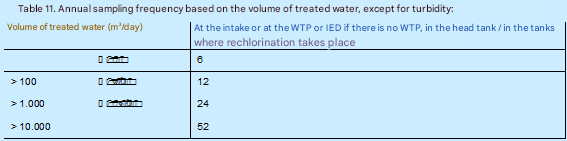
In the Table 11 Annual sampling rate as a function of treated water, except turbidity.
It is observed that it indicates in the tanks where it is reclosed, which are the ones that are installed in the hotel buildings.
Royal Decree 3/2023, of January 10 Guide for its implementation.
In the Table 13 The number of minimum tap samples per year is set in priority buildings.
All the requirements established in the tables must be completed on the dates set.
Responsible for carrying out is the Facility Holder
Annex III Sampling and analysis methods
Annex VIII PSA in priority buildings
Annex IX materials in contact with water
Specifies the materials in contact with water, (organic, metallic, cementitious, enamel and ceramic materials)
existing facilities
1
The analyzes to which the drinking water must be subjected are very restrictive, specifying very low tolerances.
Currently some existing installations will hardly meet some of these parametric values.
It will be necessary to analyze deposits and cisterns, implementing everything required and in which non-compliances are observed, such as the position of sanitation, covering, drainage system, verifying that it is only used in drinking water and that the network cannot access water from any other Origin.
In relation to networks, there may be unsuitable materials. The brass accessories used usually contain more lead than the admissible, in some installations there are predictably valves corresponding to thermal installations, pump groups that are not specific to drinking water, expansion tank, counters, etc. that will give rise to non-admissible parametric values in Annex I.
Connection with other installations
1
Drinking water is used for filling other types of installations.
In plumbing facilities, water supply to other facilities is required. (cooling, heating, solar energy, heat pumps, heat recovery from condensation, irrigation, etc.)
Systems commonly used by check valve are incorrect and do not protect the installation of the water inlet of closed circuits not suitable for human consumption.
Therefore, it will be necessary to analyze all these connections and proceed to their correction.
Replacement of materials, elements and equipment.
All the new installations or reforms of the existing ones, it is mandatory to carry them out following the specifications of this Royal Decree.
Any new material that is installed must have the suitability certificate issued by the manufacturer.
The responsibility lies with the owner of the facility.
Conclusions.
The Royal Decree 3/2023, of January 10, which establishes the technical-sanitary criteria of the quality of consumption water, its control and supply, It is applicable in all hotel facilities.
It ranges from the water collection to the outlet through the tap.
- equal to or less than 500 accommodation places
- greater than 500 accommodation places (priority buildings)
The new facilities and the reforms of the existing ones, it is mandatory to carry them out following the specifications of this Royal Decree.
Parametric values and tolerable parameters are set. In the event that the limits are exceeded, it is necessary to carry out the necessary reforms.
Responsibilities are established that fall on the Facility Holder
The quality of the drinking water is defined
It requires the preparation of a series of documents maintenance results and laboratory analysis based on the characteristics of the hotel complex.
Establishes constructive and purging requirements.
It requires the intervention of personnel and laboratories with the required qualifications.
It requires the sending of documents and availability of the tests carried out in the priority buildings.
It will be necessary to make changes in the existing facilities because the analyzes will detect situations in which the water is not suitable for consumption.
Any new material or equipment that is installed requires the corresponding certificate of suitability of the manufacturer in accordance with the provisions of this Royal Decree.
It is necessary to prevent water from reaching the drinking water network from other installations, which can seriously contaminate it, such as the closed circuits of thermal installations.
literature
1
Royal Decree 3/2023, of January 10, which establishes the technical-sanitary criteria of the quality of consumer water, its control and supply, is applicable in all hotel facilities.
https://www.boe.es/boe/dias/2023/01/11/pdfs/boe-a-2023-628.pdf
Royal Decree 3/2023, of January 10 Guide for its implementation. July edition ́23
https://www.cni-instaladores.com/wp-content/uploads/2023/07/guia_rd_3_2023_230705.pdf
Water sanitary plan in priority buildings. (Questionnaire for data collection to be notified to EDIBASE
https://www.sanidad.gob.es/areas/sanidadambiental/Calidadadaguas/Aguasconsumohumano/edibase/home.htm
edibase manual
https://ulbios.com/wp-content/uploads/2024/06/manual_edibase-1.pdf
Priority buildings Actions to be carried out
22/10/2024
José Arroyo Martín
Ingeniero Tecnico Industrial en Electricidad y Mecánica